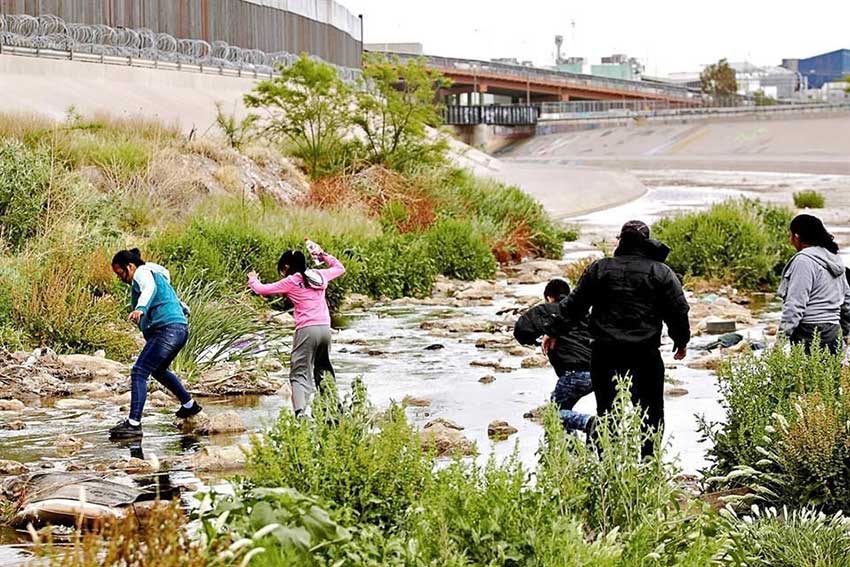
International migrants and Mexicans who have been deported from the United States are flooding into Ciudad Juárez, Chihuahua, placing a heavy strain on local resources.
More than 1,000 migrants arrived in the northern border city this week, 95% of whom are Cubans who were previously stranded in Chiapas as they waited to be issued with transit visas.
Enrique Valenzuela, director of the State Population Commission (Coespo), said that an average of 62 migrants arrived daily in Juárez during January and February but the number spiked to 110 in March.
This week, 260 migrants arrived on Monday, 252 on Tuesday, 350 on Wednesday and 177 yesterday, adding up to a total of 1,039.
Since October, more than 12,000 migrants have arrived in Ciudad Juárez, and at least 3,200 remain in the city.
Most faced – or continue to face – long waits to request asylum due to the introduction of a “metering” system that limits the number of cases United States immigration authorities will hear on a daily basis.
While the number of would-be asylum seekers arriving in Juárez is on the rise, so too is the number of people sent to the border city by United States authorities.

According to Coespo, there were 1,300 repatriations to Ciudad Juárez in each of January and February but in March the figure increased to 1,800.
In light of the situation, municipal authorities are asking state governments to cover the costs of returning Mexican deportees to their places of origin.
“[Mayor Héctor Armando Cabada] is talking to all the states so that they support their fellow citizens; we can’t leave them here,” said municipal human rights director Rogelio Pinal.
He pointed out that many deportees arrive without any money or the legal documents they need to find work in Mexico.
Four states – Aguascalientes, Jalisco, Colima and México – have so far agreed to pay travel costs so that those deported from the United States can return to their home towns in Mexico.
The federal government allocated 10.7 million pesos (US $570,000) to a migrant support fund last year to help states cover accommodation and transportation expenses for deported Mexicans but no additional funding was provided for 2019.
Chihuahua Governor Javier Corral met with Interior Secretariat (Segob) undersecretary Zoé Robledo this week to request that the funding be reinstated.
In addition to would-be asylum seekers and deportees, non-Mexican migrants who are awaiting the outcome of their asylum requests in the United States are also being sent to Ciudad Juárez.
The United States government resumed its so-called “Remain in Mexico” policy this week after halting it for a few days following a federal court ruling.
On April 8, Judge Richard Seeborg in San Francisco blocked the Trump administration from returning asylum seekers to Mexico on the grounds that its policy “lacks sufficient protections against aliens being returned to places where they face undue risk to their lives or freedom.”
However, an appeals court last Friday overturned the ruling, allowing the U.S. government to resume the policy.
The Mexican government has rejected the “Remain in Mexico scheme,” which is officially called the Migrant Protection Protocols, although it has accepted returning migrants “for humanitarian reasons.”
United States authorities this week returned 75 migrants to Ciudad Juárez under the scheme, the newspaper El Diario reported, and almost 400 migrants, most from Central America, have now been sent to the city to wait for their asylum cases to be heard in the U.S.
Most have been staying in shelters or churches but one group of 38 migrants is currently housed in a fire station, the newspaper Reforma said.
Some have chosen to return to their countries of origin rather than waiting in Juárez with no certainty about when they will be summoned to appear in court.
However, there is some evidence that the wait will not be as long as many migrants expect, although it appears that those traveling with children are being given priority.
Francisco Javier Calvillo, a priest and director of the Casa del Migrante shelter in Ciudad Juárez, said that four families were summoned by United States authorities on Wednesday and that two women and one man – each of whom were staying in the city with a child – were called yesterday.
“They crossed [the border] and they haven’t told us anything but they haven’t returned,” he said.