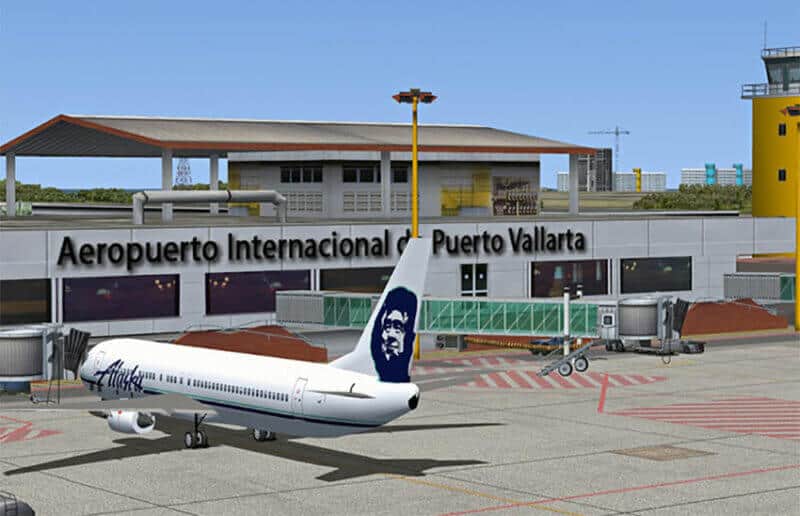
Tourism is recovering in the Pacific coast resort city of Puerto Vallarta, Jalisco, even as Mexico endures a worsening third wave of the coronavirus pandemic.
Passenger traffic at the city’s airport was up 14.4% in July compared to the same month of 2019, while hotel occupancy rates were just below pre-pandemic levels.
A total of 457,100 passengers used the airport last month, according to its operator GAP, an increase of 57,600 compared to July 2019. International passengers outnumbered domestic passengers by 11% with 240,800 of the former and 216,300 of the latter.
Passenger traffic for the first seven months of the year – just over 2.1 million – was 33.2% lower than in the same period of 2019.
Still, the figure for July is encouraging, especially considering that the (now former) Puerto Vallarta head of the Mexican Employers Federation (Coparmex) said a year ago that it could take five years for tourism to recover to pre-pandemic levels.
Compared to 2020 – the worst year in living memory for tourism destinations across Mexico – passenger traffic at Puerto Vallarta airport was up 361% in July and 32.7% in the first seven months of the year.
The increase helped hotels in Puerto Vallarta achieve an average occupancy rate of 70%, according to data cited by the newspaper Reforma. The figure is only 7.7% below the average occupancy level in July 2019.

“We’re going well; we believe tourism has recovered quite well,” said Jorge Careaga, the former Coparmex chief who made the five-year recovery prediction.
Other GAP airports that recorded increases in passenger traffic last month compared to July 2019 were those in Manzanillo, Colima, (+16.4%), Morelia, Michoacán (+13.5%), Los Cabos, Baja California Sur (+11.1%), Tijuana, Baja California (+10.7%) and Aguascalientes city (+4%).
Passenger numbers at GAP’s six other Mexican airports – Guadalajara, Guanajuato, Hermosillo, Mexicali, La Paz and Los Mochis – were all down in July compared to two years earlier.
The decline in the Jalisco capital was 14.4% to just under 1.2 million, while La Paz, the capital of Baja California Sur, recorded the largest drop – 17.5% to just over 88,000.
Hotel occupancy in Guadalajara nevertheless increased compared to previous months to 53% in July, according to Gustavo Staufert, director of the Guadalajara Visitors and Conventions Office. That figure is 9.5% below July 2019 levels.
Staufert said that hotel reservation data for the second half of the year shows that Guadalajara is the fifth most “booked” destination in the country and Puerto Vallarta is No. 3.
“When you add Vallarta and Guadalajara together, Jalisco becomes No.2 [among the 32 states] for the quantity of reservations,” he said, citing data from online travel agency Expedia.
With reports from Reforma