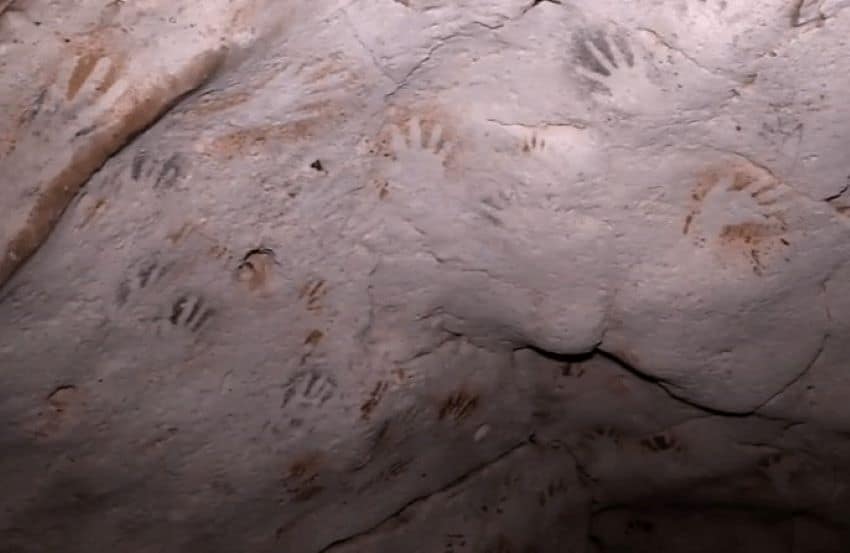
More than 100 black and red handprints that date back over a thousand years have been discovered on the walls of a cave on the Yucatán peninsula.
According to a report by the news agency Reuters, 137 prints — most of which are believed to have been made by children’s hands — were found in a cave near the northern tip of the peninsula. Archaeologists have determined that they are more than 1,200 years old.
The date the handprints were made corresponds to the end of the ancient Mayan society’s classical zenith, a time at which major advances in math and art were being made. The cave in which they were found is located some 10 meters beneath a ceiba tree, considered sacred by the ancient Mayan people.
Sergio Grosjean, an archaeologist who has explored and studied the cave, told Reuters that the handprints are likely associated with a coming-of-age ritual of the ancient Mayan people. He said they were probably made by children upon reaching puberty.
“They imprinted their hands on the walls in black … which symbolized death, but that didn’t mean they were going to be killed, but, rather, death from a ritual perspective,” Grosjean said.
“Afterwards, these children imprinted their hands in red, which was a reference to war or life,” he said.
Other Mayan artifacts have also been found in the cave, including a carved face and six painted relief sculptures. Dating from between 800 and 1,000 A.D., the sculptures were made at a time when the Mayan region was experiencing severe drought that may have caused inhabitants to suddenly abandon major cities that are today archaeological sites visited by tourists.

Grosjean was also part of a team of archaeologists who discovered a treasure trove of Mayan cave paintings in the east of Yucatán state in 2018. That cave also has handprints on its walls.
“It’s not the only cave with paintings in Yucatán, but it is the most important because they have many elements: birds, mammals, a cross, geometric figures, human forms and, among those, that of a warrior as well as [prints made with] the front and back of hands,” Grosjean said at the time.
Source: Reuters (en)