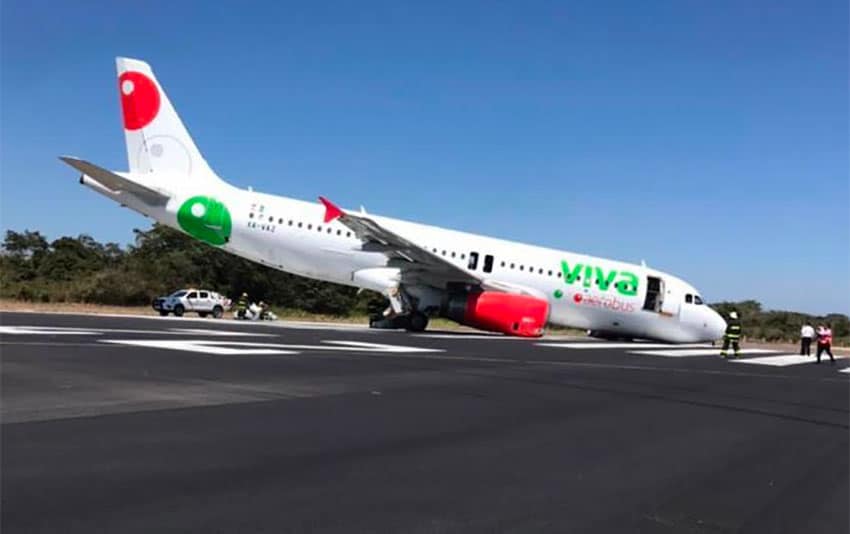
A VivaAerobus aircraft lining up to take off from Puerto Vallarta International Airport Thursday afternoon sustained a nosegear collapse, forcing the airport to close temporarily while a maintenance check was conducted on the plane.
None of the 127 passengers and crew on board flight 4343, which was bound for Monterrey, Nuevo León, was hurt, the airline said. In accordance with the airline’s safety policies, all were evacuated via slides.
The passengers were transferred to another flight to Monterrey.
It was the first landing gear failure in the discount airline’s operating history, according to the aviation publication Aerotime Hub.
The nosegear collapse occurred as the Airbus A320 was backtracking on the runway in preparation for takeoff and made a 180-degree turn to line up, according to Aviation Herald.
The Mexican airline, based out of Monterrey, uses 43 Airbus A320 planes that have an average of 4.5 years of service in VivaAerobus’s fleet, according to Aerotime Hub, which also said that the aircraft in question was 15 years old.
“We regret the inconvenience that this incident has caused and reaffirm our commitment to security on each of our flights, our company’s No. 1 priority,” VivaAerobus officials said in a statement Thursday

Aerotime Hub (en), The Aviation Herald (en)