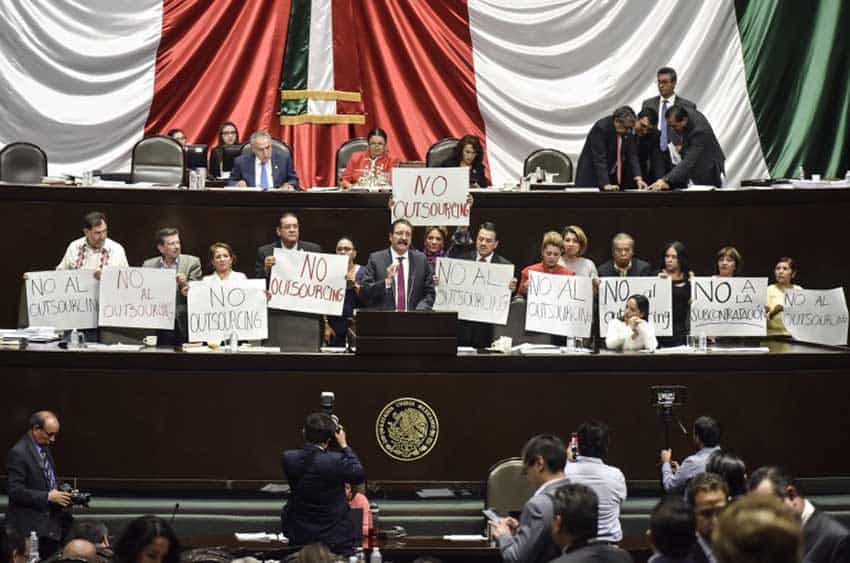
The lower house of Congress approved a landmark labor reform package yesterday, legislation that is considered crucial for the ratification of the new North American trade agreement in the United States.
A majority of deputies endorsed changes to five different laws including the Federal Work Law.
The reform eliminates conciliation and arbitration boards, replacing them with federal tribunals and a new body called the Federal Center for Labor Registry and Conciliation.
It also democratizes unions by giving workers the right to elect their leaders in free and secret ballots, and unions will be empowered to bargain more effectively on behalf of their members.
The reform also has provisions to protect workers’ human rights and gender equality and stamp out discrimination in the workplace.
“The reform is very clear,” said Mario Delgado, leader of the ruling Morena party in the Chamber of Deputies.
“The authorities must ensure that union leadership is overhauled and that every four years workers vote on their collective bargaining contracts.”
The lawmaker said that Mexico now has the opportunity to put an end to charrismo sindical, a term used to describe union corruption.
The labor reform will be sent to the Senate for debate and a vote. Its approval of the reform is expected later this month.
President López Obrador recently called on the Congress to approve the reform so that Mexico’s labor laws are consistent with provisions set out in the United States-Mexico-Canada agreement (USMCA), which leaders of the respective countries signed in November.
“It’s in our interest to have this treaty and for there not to be any excuse to reopen the negotiation,” he said yesterday.
While Morena party lawmakers in the lower house took the president’s advice, deputies from its coalition partner, the Labor Party (PT), unanimously voted against the reform.
“ . . . If we agree with what this reform sets out . . . why vote against it? Because we think it’s inadequate, we believe that a labor reform that doesn’t include the elimination of outsourcing . . . isn’t a reform that is up to the standard of the fourth transformation,” said PT deputy Gerardo Fernández Noroña, using the term used by the president to describe the change his government will bring to Mexico.
National Action Party (PAN) Deputy Arturo Espadas said the reform had been rushed through and wondered whether lawmakers were “obeying the president of a neighboring country.”
In order for the USMCA to be ratified in the United States, the Democratic Party, which has a majority in the House of Representatives, has said that enforcement of labor provisions in the USMCA is key.
On April 2, House Speaker Nancy Pelosi said the United States Congress wouldn’t ratify the agreement until its Mexican counterpart approved the labor reform.
An annex of the USMCA, which will replace the 25-year-old NAFTA, explicitly requires Mexican workers to vote on union decisions and their contracts.
Union elections have commonly been rigged in Mexico and workers have sometimes been coerced to vote against their will.
Source: El Universal (sp), El Economista (sp)