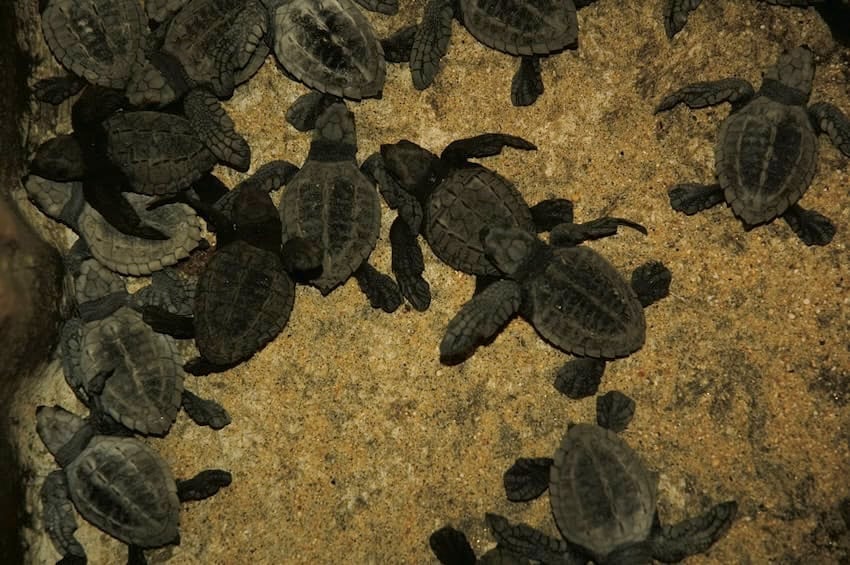
More than 100,000 olive ridley sea turtles came ashore at Oaxaca’s Playa Escobilla in a single mass nesting event last week, but the spectacle masks a fragile reproductive outlook: As few as 30% to 40% of the eggs may hatch.
According to the newspaper El Universal Oaxaca, 101,500 females emerged from the Pacific Ocean in Santa María Tonameca last Tuesday in a huge, synchronous nesting event known as an arribada.
The sixth arribada (literally “arrival” in Spanish) of the 2026-27 season lifted the season’s running total to more than 465,000 turtles as of last week, according to the paper.
The olive ridley turtle is among the smallest species of sea turtle in the world. They are found primarily in tropical regions, with a nesting season that generally runs from May through February or March.
Playa Escobilla is among the world’s leading nesting sites for the olive ridley, or Lepidochelys olivacea.
The species is listed as endangered in Mexico and faces risks from egg poaching, fishing, destruction of nesting habitat and climate-related events. Conservation efforts are abundant all over Mexico, and volunteer opportunities are many, as detailed this month in Mexico News Daily.

Despite the current large Escobilla tally, Rafael Villanueva Alcázar of the National Commission of Natural Protected Areas (Conanp) cautions that nesting totals do not guarantee a comparable increase in hatchlings.
“It sounds like a lot,” he said, “but it’s actually very low compared to other beaches that have a higher rate of hatchling production.”
Only about 30% to 40% of Escobilla nests hatch, Villanueva said. By comparison, Playa Ceuta in Sinaloa estimates an 85% hatch rate, but it has only about 500 olive ridley nests per season.
No global hatching rate for sea turtle nests could be found, but one widely cited statistic is that roughly one in every 1,000 sea turtle hatchlings worldwide survives to adulthood.
Rising sand temperatures, changes in sand composition, erosion, strong swells and low humidity are among the factors reducing hatching success. Egg theft and other human-caused damage also take a toll.
Conditions can vary sharply between seasons and sanctuaries.
At Morro Ayuta, another major olive ridley refuge on Oaxaca’s coast, a record 1.9 million olive ridley nests were protected and more than 34 million hatchlings were released into the sea during the 2025-26 season.
Guillermo González Padilla, the head of that turtle camp, said those numbers were “unprecedented” thanks to “the rains, the wetter beaches and the fact that the summer’s temperature [in 2025] was ideal for egg incubation.”
(For this season, Morro Ayuta had counted about 135,000 turtles through the start of its third arribada earlier this month, according to Conanp.)
Meanwhile, at Escobilla, conservation work over the past 35 years has helped. Officials set aside a 5-kilometer protected area for nesting during last week’s arribada, and Conanp is monitoring the nesting grounds along with other federal agencies and local communities.
Local participation is critical because available park rangers alone cannot protect the beach from poachers and other threats. Also, according to EDUCA, a Oaxacan community development NGO, locals help strategically relocate eggs — which average 100 per nest — after arribadas.
With reports from El Universal Oaxaca and MeganoticiasMx