The federal government has designated the Maya Train railroad as a project of national security, a move designed to prevent it from being stopped or delayed by legal challenges.
Javier May, director of the National Tourism Promotion Fund (Fonatur), said Monday that the decision was taken at a National Security Council meeting last week.
“It’s an issue of national security. There was a National Security Council declaration saying the project is a priority and a national security issue,” he told reporters during an interview in the National Palace.
As a result of the declaration, May said, the 1,500-kilometer railroad project is now the responsibility of the Interior Ministry and the Security Ministry, although it is being managed by Fonatur.
The official acknowledged that the declaration doesn’t invalidate existing injunctions – including a definitive suspension order – against section 5 of the project, which will run between Cancún and Tulum. May said that Fonatur would respect the current suspension orders, which stopped work on the southern part of section 5 (Tramo 5 Sur) due to an absence of an authorized environmental impact statement (EIS).
The federal Environment Ministry (Semarnat) late last month approved the EIS for Tramo 5 Sur, putting Fonatur in a position to file for the revocation of the suspension orders. May said the agency he heads is waiting for the opportunity to present its case against the injunctions in court.
“We’re waiting for the hearing to be set, it has been postponed several times,” he said. “… The environmental impact statement was already granted.”

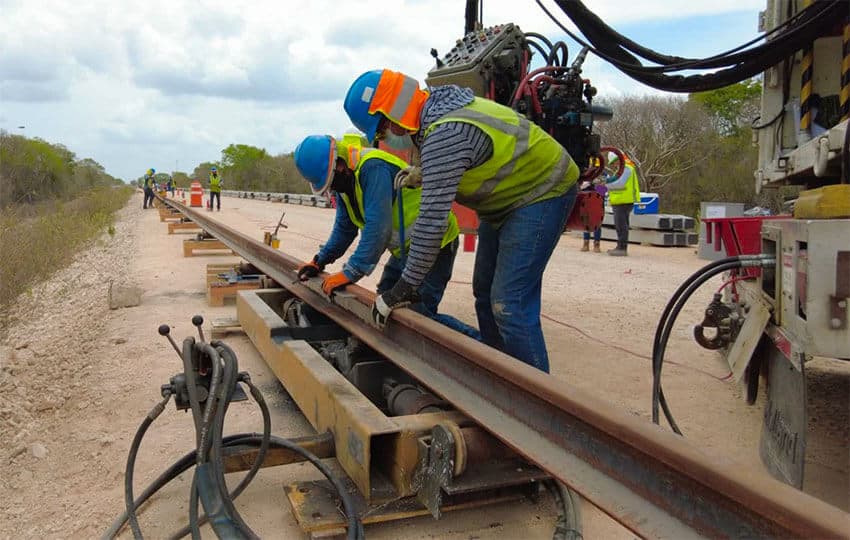
Although suspension orders against Tramo 5 Sur remain valid, work resumed on the project last week. Asked whether the national security declaration allowed the resumption of work, May responded:
“Yes, that’s right. In the Security Council session they determined that it is a project of national security due to the railroad tracks and … it was the Security Ministry and the Interior Ministry that determined that the project should restart.”
The Fonatur chief rejected the suggestion that the resumption of work violated court orders against Tramo 5 Sur. “No injunction is violated, we’re not intervening. It’s not Fonatur … that is carrying out the project, the Interior Ministry and the Security Ministry are carrying it out,” May said.
Environmentalists, who have challenged the project on the grounds that it will cause irreversible damage to jungle and cenotes (natural sinkholes), rejected his assertion. A lawyer for Defendiendo el Derecho a un Medio Ambiente Sano (Defending the Right to a Healthy Environment) – a Cancún-based organization that obtained the definitive suspension order against Tramo 5 Sur on behalf of three speleologists – said the government is guilty of contempt of court.
“It’s very serious, it seems we live in different universes. I don’t know what law … [the government] follows,” said Antonella Vázquez.
“That the government is breaking the law is a threat to all of us,” said Pepe Urbina, one of the speleologists. The government is seeking to “comply with a political calendar, not … [create] a public benefit,” he said.
The Maya Train national security declaration comes eight months after President López Obrador moved to protect and fast-track the federal government’s infrastructure projects from legal challenges and scrutiny by issuing a decree that establishes them as matters of public interest and national security. The National Security Council declaration appears to provide extra protection to the Maya Train.
In an interview with the newspaper El País, Fonatur’s Maya Train spokesperson Fernando Vázquez noted that the 2021 decree is general in nature and applies to “all priority projects” whereas the latest declaration specifically applies to the Maya Train.
López Obrador, who says that the project will spur development in Mexico’s southeast, has pledged that the railroad – which will run through Tabasco, Campeche, Yucatán, Quintana Roo and Chiapas – will begin operations in 2023.
However, the northern stretch of section 5, which will link Cancún to Playa del Carmen, isn’t expected to be finished until July 2024, according to an EIS submitted to Semarnat last week.
With reports from Reforma, El Economista and El País