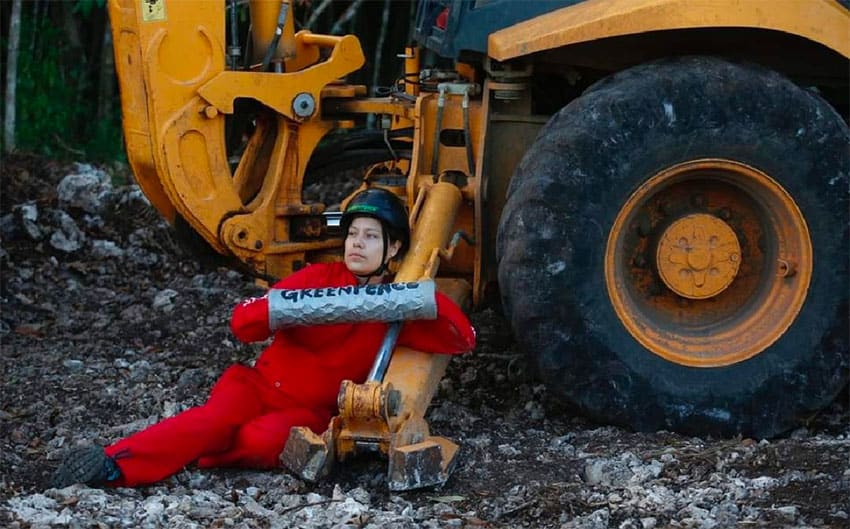
Activists from Greenpeace tied themselves to heavy machinery on Monday to impede work on a Quintana Roo section of the Maya Train railroad.
Eight protesters from the environmental organization began their protest in the municipality of Solidaridad at 7:00 a.m. and intended to remain tethered to the machinery all day, the newspaper Milenio reported.
The federal government recently modified the route for section 5 of the railroad, moving the Cancún-Tulum stretch inland after the business community in Playa del Carmen complained about its construction through the center of the coastal resort city.
Jungle has already been cleared for the construction of tracks along the modified route, triggering protests both at the site of the deforestation and online.
The Greenpeace protesters said that section 5 was rerouted to run through jungle before environmental studies were completed.
They also said that the damage to flora, fauna and subterranean rivers in Quintana Roo will be irreversible, and urged people to sign a Greenpeace petition against the “devastation of the Mayan jungle.”
Aleira Lara, campaigns director for Greenpeace México, called on President López Obrador to immediately suspend construction of section 5 of his US $8 billion signature infrastructure project, which is slated for completion in 2023 and will run through Tabasco, Campeche, Yucatán, Quintana Roo and Chiapas.

“As it is planned, this route will fragment, deforest, strip of animals [and] contaminate … the jungle, the rivers and the communities,” she said.
The likelihood of López Obrador agreeing to suspend section 5 of the railroad is extremely low. He has rejected claims that the Maya Train project will cause extensive environmental damage and described its opponents as “pseudo-environmentalists.”
“In 1,500 kilometers of the train, only 100 hectares [of vegetation] will be affected, mainly weeds. However, at the same time 200,000 hectares are being reforested; three large natural parks (18,000 hectares) will be created and on the edge of the tracks, rows of flowering trees will be planted,” López Obrador wrote in a Facebook post earlier this month.
On Monday, he celebrated that the ambitious rail project no longer faces any legal impediment after a Mérida-based federal court last week lifted a suspension of environmental permits for sections 1,2 and 3 that was first issued in March 2021.
The court ruled in favor of maintaining the suspension of the permits in February, but acknowledged that doing so was a mistake because it previously revoked the same suspension in December.
López Obrador told reporters at his regular news conference that there is now “no legal problem” for sections 1, 2 and 3, which will connect Palenque, Chiapas, to Izamal, Yucatán, or any other sections. “There was an injunction but it has already been ruled against,” he said.
AMLO reaffirmed that construction of section 5 won’t cause major environmental damage.
“A new route was chosen, … the entire right-of-way is already in place. Reaching Tulum there are cenotes [natural sinkholes] but the project has taken into account viaducts to go through there. They won’t be touched, the subterranean rivers and cenotes won’t be affected at all,” he said.
López Obrador said that most of the land along which the modified route will run is owned by hotels and has already been altered. “It’s not jungle, it’s grasslands,” he said.