The mayor of Tijuana has declared a humanitarian crisis due to the massive number of Central American migrants who have swamped the city.
Juan Manuel Gastélum, who has been labelled Tijuana’s Trump because of anti-migrant rhetoric last week, told a press conference yesterday that the declaration is in accordance with articles in the federal Migration and Refugee laws.
Attending to the thousands of mainly Honduran caravan members is costing the city more than 500,000 pesos (US $25,000) a day, he declared.
Gastélum called on the United Nations Office for the Coordination of Humanitarian Affairs (OCHA) and other international organizations to assist with the situation in the absence of federal support.
“I’m asking for international organizations to intervene because more than 4,700 Central American migrants are stranded and crowded together in the city in precarious conditions . . . the federal government hasn’t intervened despite it being their constitutional duty,” he said.
The mayor urged President Peña Nieto and Interior Secretary Alfonso Navarrete to assume responsibility for the migrants, taking particular aim at the latter’s department (Segob) for leaving municipal authorities to deal with the situation on their own.
“Mexican laws establish that [Segob] is the department responsible for dealing with the issue from the beginning,” Gastélum said.

“I’m not going to compromise public services, I’m not going to spend the money of the people of Tijuana, I’m not going to put Tijuana into debt . . .” he declared.
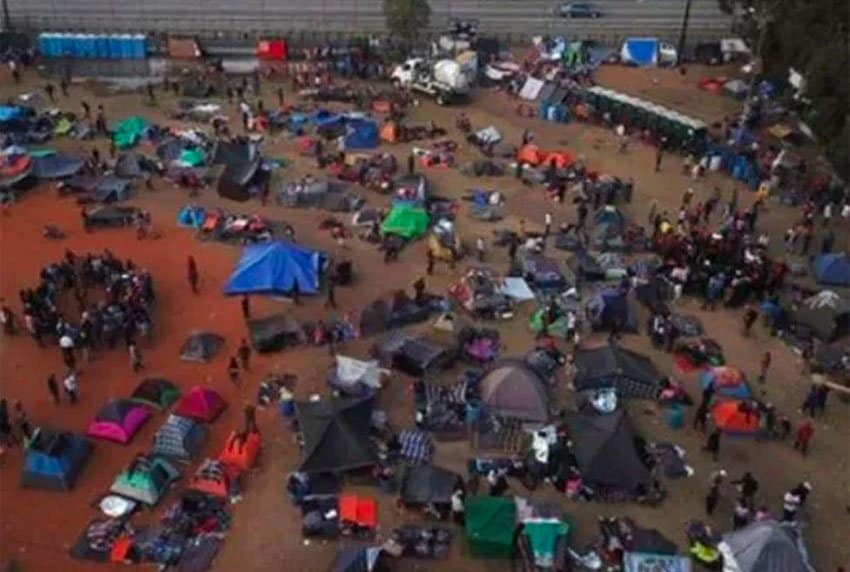
Most of the migrants currently in Tijuana have been staying in a sports complex that has been converted into a shelter, and many of them are sick with illnesses including influenza and respiratory infections.
Around 200 Central Americans – mostly families with children who are tired of the crowded conditions at the shelter – have set up their own camp in the street right next to a border crossing point.
One group of migrants staged a protest yesterday within 150 meters of the border to demand better conditions in the Benito Juárez sports center-cum-shelter and to try to present themselves to U.S. authorities for asylum.
“There are sick children here, and we are cold and hungry,” protest leader Carlos López said.
The migrants, who traveled more than 4,000 kilometers to reach the Mexico-United States border, hope to lodge asylum requests with U.S. authorities but due to the large number of them and an existing backlog it could be months before they have the opportunity to do so.
Thousands more migrants are currently traveling through Mexico and many of them are likely to join the large cohort already in Tijuana.
On Wednesday, The Washington Post reported that the Trump administration is preparing sweeping new measures that would force Central Americans who arrive at the border to wait in Mexico while their asylum claims are processed, although a spokeswoman for the Department of Homeland Security (DHS) said that there were no immediate plans to change immigration policy.
Such a change would put even greater pressure on the municipal government of Tijuana.
Source: Animal Político (sp)