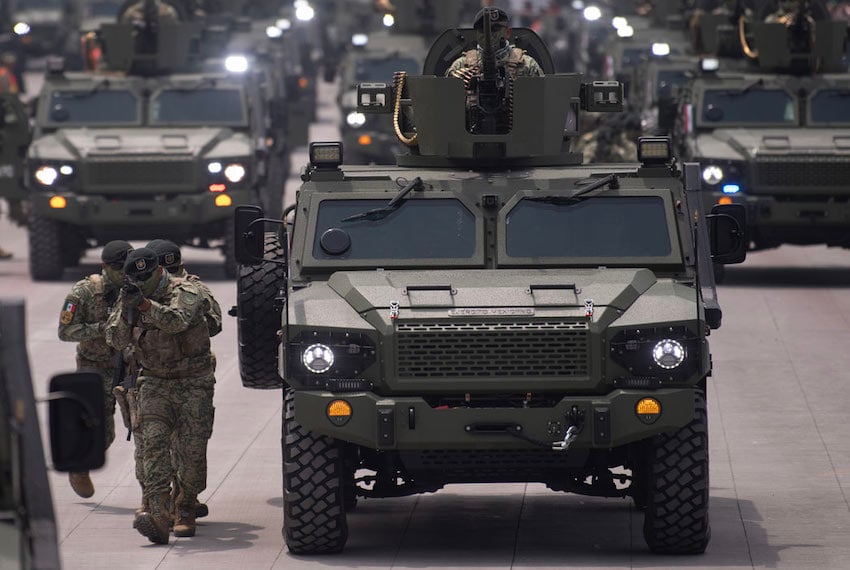
In a mission supported by units from a new fleet of armored military vehicles, a large detachment of Mexican Army and National Guard personnel is providing security to the avocado industry in and around Uruapan, the municipality in Michoacán where the mayor was assassinated last month.
Some 720 soldiers and National Guard members have been deployed to the Uruapan area to ensure that avocado production can continue without the intervention of organization crime, according to a report published by the newspaper Milenio on Wednesday.
The avocado industry in the state of Michoacán — easily Mexico’s top producer and exporter of the fruit colloquially known as “green gold” — has long been targeted by criminal organizations, which extort farmers.
Now, however, the “constant surveillance” of avocado farms and packing facilities by soldiers and National Guard personnel “has created an environment of safety and confidence among workers,” wrote Milenio, which reported from Uruapan.
A Milenio video report shows federal security forces patrolling an avocado farm and observing workers inside a packing plant.
The security mission in Uruapan is supported by 74 military vehicles, including bullet-resistant Ocelotl vehicles, manufactured by the United Arab Emirates-based company Streit Group and outfitted locally according to Mexican Army specifications. The vehicles’ name means jaguar or ocelot in Nahuatl, an Indigenous language spoken mainly in central Mexico.
Se va poner bueno…
Se dejan caer los Ocelotl del 🇲🇽🪖Ejército mexicano a Sinaloa pic.twitter.com/mjyYrGJunV
— Foro Militar México (@foro_militar) August 1, 2025

Supported also by municipal and state police officers and agents from the federal Security Ministry, the “Uruapan Task Force” mission is part of Plan Michoacán for Peace and Justice, a 57-billion-peso (US $3.1 billion) initiative that the federal government devised in response to the murder of Uruapan mayor Carlos Manzo on Nov. 1 and general insecurity in the state.
Avocado producer says theft has declined 80-90%
Rosendo Díaz, an avocado producer, told Milenio that the security situation in and around Uruapan has improved since the commencement of the army and National Guard operation.
He noted that a lot of security checkpoints have been set up in order to prevent the robbery on highways of avocados and the trucks transporting them.
“[Theft] has declined a lot. I think 80% to 90%,” Díaz said.
He also said that he and other workers feel “calmer” while on the job and can arrive at and leave their workplace with a greater sense of safety.
Flanked by members of the National Guard inside a packing plant, packer Jessica Sánchez told Milenio that crime targeting the avocado industry has declined.
She also said that Uruapan residents feel a little safer than they previously did.
Milenio reported that the risk of an avocado packing plant employee in Uruapan becoming a victim of crime has declined, especially for workers who leave such facilities late at night.
An avocado “cutter” identified only as Julio told Milenio that in his 20 years of working on avocado orchards, the current security operation is the largest he has seen.
“Before, [criminals] stole [avocado] trucks a lot, but that has declined significantly due to the many checkpoints and patrols,” he said.
“… It’s more pleasant to work,” Julio added.

Across Michoacán, the federal government’s peace and justice plan achieved positive results in the first weeks after it was implemented, with homicides declining significantly in November compared to previous months.
In the first 11 months of the year, Michoacán ranked seventh out of Mexico’s 32 federal entities for homicides, with 1,191, according to data presented by the federal government last week.
The Ocelotl vehicles
The Mexican Army first showed off its Ocelotl vehicles at the 2024 Independence Day parade.
The vehicles were subsequently put into action in Sinaloa, where rival factions of the Sinaloa Cartel are involved in a bloody dispute, and in Michoacán, where they initially supported efforts to combat extortion targeting lime growers.
All told, the Ministry of Defense acquired 340 of the vehicles, which are worth more than 10 million pesos (US $555,000) each.
Milenio reported that an Ocelotl vehicle:
- Can travel up to 400 kilometers before it needs to refuel.
- Can reach speeds of up to 140 kilometers per hour.
- Can ascend steep slopes.
- Can resist impacts from bullets and even explosions.
- Has a revolving gun turret that can be adapted to accommodate any kind of firearm.
- Is equipped with snorkels that allow it to cross water.
With reports from Milenio