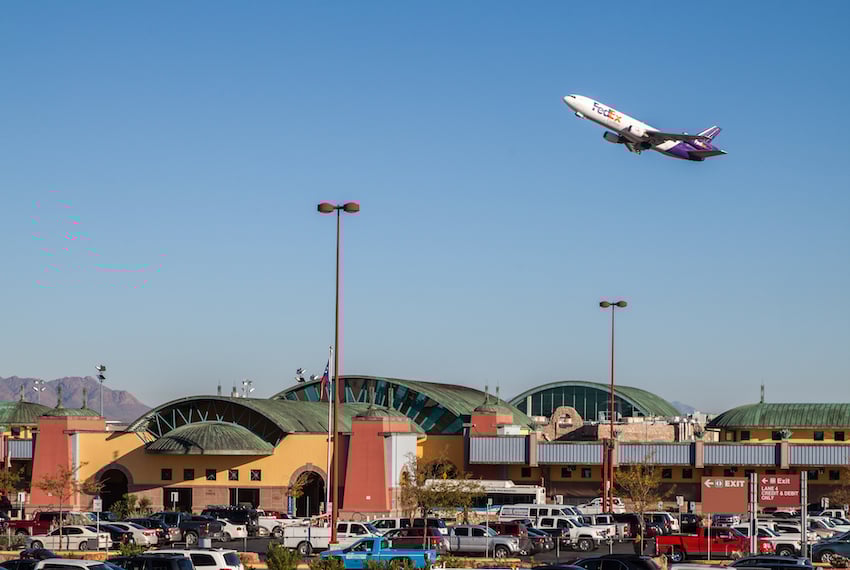
The airspace over El Paso, Texas, was closed late Tuesday after Mexican cartel drones breached the airspace, according to reports by the Associated Press and CNN that cited U.S. government sources.
U.S. Secretary of Transportation Sean Duffy subsequently said on social media that the U.S. Federal Aviation Administration (FAA) and the Department of War (DOW) “acted swiftly to address a cartel drone incursion.”
The FAA and DOW acted swiftly to address a cartel drone incursion.
The threat has been neutralized, and there is no danger to commercial travel in the region.
The restrictions have been lifted and normal flights are resuming. https://t.co/xQA1cMy7l0
— Secretary Sean Duffy (@SecDuffy) February 11, 2026
“The threat has been neutralized, and there is no danger to commercial travel in the region,” he wrote on X Wednesday morning.

Earlier on Wednesday, the FAA announced on social media that the “temporary closure” of airspace over El Paso had been lifted, just hours after it said in a Notice to Airmen that aircraft could not fly above El Paso for 10 days, from Feb. 11 to Feb. 21, for “Special Security Reasons.”
The closure would have prevented flights from landing at or departing from El Paso International Airport until the following Saturday. Airspace above Santa Teresa, New Mexico, located about 24 kilometers northwest of El Paso Airport, was also temporarily closed. Mexican airspace was not affected.
On Wednesday morning, the FAA said there was “no threat to commercial aviation,” adding that “all flights will resume as normal.”
The Associated Press reported on Wednesday that it was told by a Trump administration official that the airspace over El Paso was closed after Mexican cartel drones breached the airspace, while CNN cited a U.S. government official as saying the same thing.
“The Department of War took action to disable the drones,” the unnamed official told CNN.
“The FAA and DOW have determined there is no threat to commercial travel.”
AP said that the official it spoke to didn’t say how many drones breached the airspace above El Paso — located opposite Ciudad Juárez, Chihuahua — or explain what specifically was done to disable the unmanned aerial vehicles.
NBC News and ABC News also reported that they were told by a Trump administration official that Mexican cartel drones had breached U.S. airspace, but the DOW disabled them.
The Texas Tribune acknowledged that the U.S. government “says the unusual closure was triggered by Mexican cartel drones breaching U.S. airspace,” but said that information contradicted “an industry source who said it was because of an impasse with the Department of Defense [as the DOW was previously known] over the use of unmanned military aircraft.”
“An industry official, who had been briefed on the matter by the FAA in a morning call and asked not to be identified, told the Tribune that the Defense Department has been operating unmanned aircraft, or drones, against drug cartel operations from a base near El Paso’s airport without sharing information with the FAA,” the Tribune reported.
“It has to do with the FAA’s inability to predict where [unmanned aircraft systems] might be flying,” the official told the Tribune. “They have been operating outside the normal flight paths.”
For its part, The New York Times reported that officials “offered conflicting explanations for a temporary closure of airspace over El Paso.”
It noted that Duffy and other U.S. government officials attributed the closure to a breach of U.S. airspace by Mexican cartel drones, but added that “two people briefed by Trump administration officials said the shutdown was prompted by the Defense Department’s use of new counter-drone technology and concerns about the risks it could pose to other aircraft in the area.”

Mexican cartel drones have previously breached U.S. airspace, according to a senior Trump administration official.
Last July, Steven Willoughby, a high-ranking official with the U.S. Department of Homeland Security, said that “nearly every day, transnational criminal organizations use drones to convey illicit narcotics and contraband across U.S. borders and to conduct hostile surveillance of law enforcement.”
He asserted that it was “only a matter of time” before Mexican criminal organizations carried out drone attacks against U.S. citizens and law enforcement authorities.
In recent months, the Trump administration has ramped up its fight against drug trafficking, launching numerous attacks on alleged drug boats in the Caribbean Sea and the Pacific Ocean, and capturing Venezuelan President Nicolás Maduro, who is accused of leading a drug-trafficking organization.