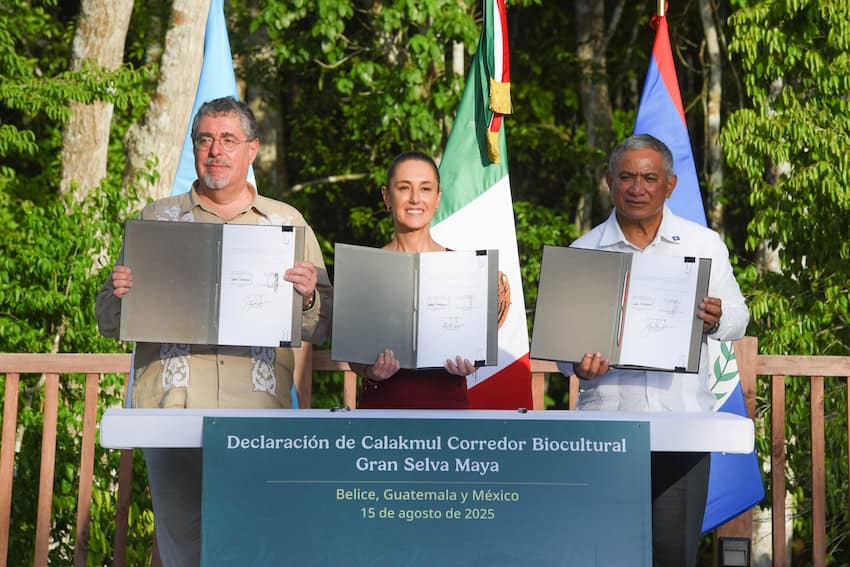
Mexico, Guatemala and Belize have created an international area called the Great Maya Forest Biocultural Corridor, dedicated to protecting and preserving the biodiversity and cultural heritage of the region.
The corridor is the result of a historic agreement between the two Central American countries and Mexico, signed at the Gran Mundo Maya Calakmul hotel in Campeche, the capital of the southeastern Mexican state of the same name.
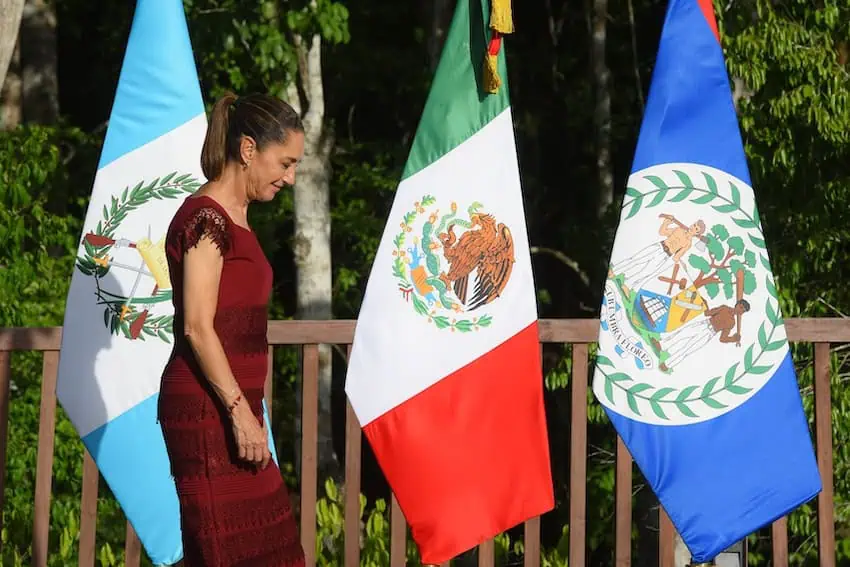
“We should be proud to be able to tell the world [that] we have united our will to preserve and restore the legacy of this extraordinary biological and cultural wealth,” President Claudia Sheinbaum said in a statement. “Today’s agreement is historic and beautiful. Thank you, President Arévalo, and thank you, Prime Minister Briceño.”
The corridor spans approximately 5.7 million hectares of tropical rainforest that is part of the legacy of the Maya civilization. It covers 600,000 hectares in Belize, 2.7 million in Guatemala, and 2.4 million in Mexico. An estimated 2 million people live across this area.
Because this region still has a large population of Maya descendants, the leaders of the three countries emphasized the importance of preserving not only the region’s biological wealth but also its living cultural heritage, presenting it as a global example of environmental and social cooperation.
“We are not only protecting an ecosystem, but also honoring the legacy of the civilization that once flourished in these territories,” Sheinbaum said.
The corridor aims to protect regional species such as the jaguar, tapir, spider monkey, and quetzal. As the second largest tropical rainforest in the Americas (after the Amazon) its preservation is key to addressing the climate crisis, regulating the water cycle, and protecting regional biodiversity.

Belizean Prime Minister Johnny Briceño said that this project is not only a commitment to biodiversity, but also “a bridge to a future where sustainable development, regenerative tourism, and ancestral wisdom guide our path.”
Meanwhile, Guatemalan President Bernardo Arévalo stressed that the three countries are working “to respond together to common threats.”
To address such threats to the environment as illegal logging, pollution and fires, the three countries have agreed to take cooperative actions like sharing information, technology, and training. They have also agreed to manage the use of timber and non-timber forest resources in an inclusive manner that benefits the communities in the areas.
With reports from La Jornada and Aristegui Noticias