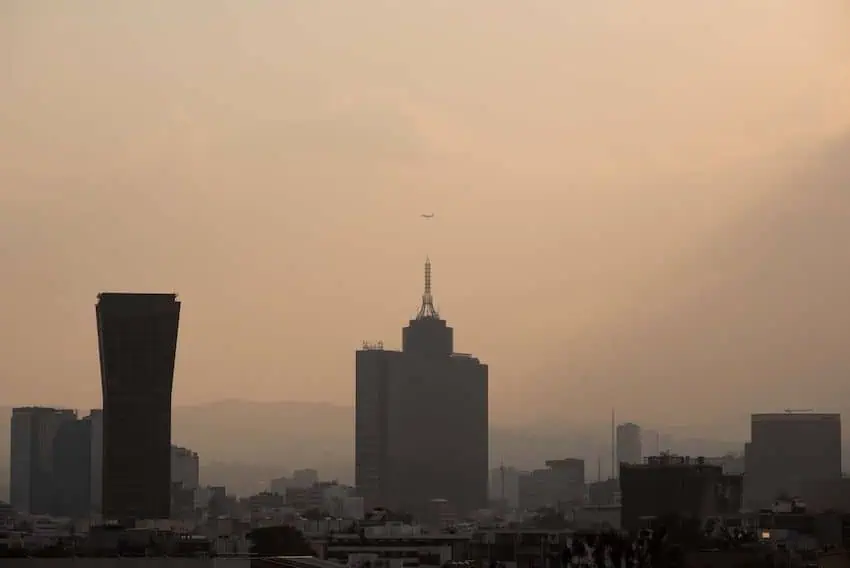
Mexico City’s government disseminated an environmental contingency warning for the third day in a row on Wednesday due to a high level of air pollution in the city and surrounding areas.
Air quality is measured on a scale of 0 to 500, with 0 being perfect. On a typical day in Mexico City, the air quality index (AQI) hovers around 100, mainly due to pollutants from vehicle emissions.
Se activa #ContingenciaAmbiental por ozono en la Zona Metropolitana de Valle de México.
¡No olvides revisar las restricciones a la circulación de este miércoles 19 de marzo! 🚗#ZMVM #CDMX #HoyNoCircula pic.twitter.com/zn9FJfUpvJ
— Secretaría del Medio Ambiente (@SEDEMA_CDMX) March 18, 2025
Mexico City’s government published this guide to driving restrictions for Wednesday, March 19, 2025 on the social media platform X on Tuesday.
The Metropolitan Environmental Commission (CAME) reported that on Tuesday, a maximum ozone concentration of 155 parts per billion (ppb) was recorded at 3 p.m. at the Gustavo A. Madero station, which rose to 167 ppb by 4 p.m.

CAME enacted Phase I of the Ozone Environmental Contingency, an initiative aimed at mitigating health risks by reducing the population’s exposure to polluted air, as well as reducing emissions to improve air quality.
The Mexico City Atmospheric Monitoring System indicated that a high-pressure system would continue to affect Mexico’s central region Wednesday. Poor ventilation, high solar radiation and temperatures of up to 28 degrees Celsius will all contribute to the poor air quality.
This is the capital’s third environmental contingency of the year so far. From January to August 2023, the city only registered 55 days of fresh air, meaning air quality was poor 77% of the time.
Restrictions in Mexico City
Metropolitan authorities have encouraged people to stay informed about the air quality levels and heed health recommendations, including avoiding exposure to pollution peaks between 1 p.m. and 7 p.m., especially for infants, older adults, pregnant women and those with respiratory and cardiovascular diseases.
People are advised to avoid outdoor exercise between 1 p.m. and 7 p.m., avoid smoking, work remotely where possible, shop online rather than in-store and avoid the use of air fresheners, aerosols, paints, waterproofing products or products containing solvents.
Traffic restrictions have also been imposed to help reduce emissions. Between 5 a.m. and 10 p.m., private vehicles with verification hologram 2, with hologram 1 and whose last digit is 1, 3, 4, 5, 7, or 9, and cars with holograms 0 and 00 with a red sticker, and license plates ending in 3 and 4, must be suspended from circulation between 5 a.m. and 10 p.m.
Restrictions on industrial operations also apply. Certain manufacturing industries must reduce emissions by 40% and suspend maintenance, cleaning and other activities that generate pollutants.
Monitoring Mexico City’s air quality
To get an accurate reading of the air quality in your colonia, visit aire.cdmx.gob.mx, which also offers more information on pollutants by neighborhood.
The AQI also offers an air pollution monitor.
With reports from La Jornada