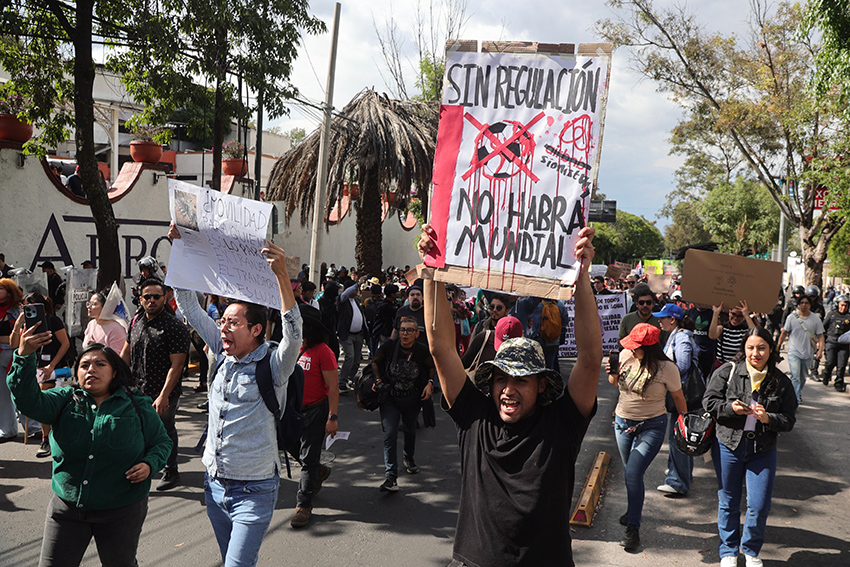
For the second time in just over two weeks, Mexico City was the scene of an anti-gentrification protest march that turned violent. And once again, the vandalism appeared to be carried out by interlopers who were not members of the groups that organized the protest.
President Claudia Sheinbaum on Monday denounced the vandalism, singling out for condemnation the burning of books at the national university.
“The only people who have ever burned books are fascists,” she said. “There may be legitimate demands, but burning books in an educational institution must be condemned.”
Sunday’s protesters, marching in the southern Mexico City borough of Tlalpan, railed against real estate speculation ahead of the 2026 FIFA World Cup. The location of the march was selected to defend the neighborhoods in the vicinity of Banorte Stadium, the monumental stadium formerly known as Azteca Stadium that will host five World Cup matches next year.
Organizers and local residents said they fear that realtors and developers will seek to upgrade property for moneyed visitors attending the World Cup. They also criticized the environmental damage construction and renovations in the area could cause.
One target of their ire was the so-called Fuentes Brotantes megaproject, a large housing development in Tlalpan being built by the Graus Arquitectura construction company in the Santa Úrsula Xitla neighborhood, a pueblo originario (original town).
A pueblo originario is a pre-Columbian settlement that has maintained its social, historical and political characteristics, and is formally recognized as such by the Mexico City government.

Last November, borough authorities temporarily halted the Fuentes Brotantes project but Sunday’s protesters demanded that the project be permanently canceled.
Sunday’s protesters also demanded affordable housing, denounced displacement from their homes by developers and wealthy outsiders and rejected the “accelerated touristification” of residential neighborhoods.
Some participants held signs decrying government policies “that serve the interests of capitalism” and effectively price students and young adults out of certain neighborhoods. Others chanted slogans such as “This is not development, it is eviction.”
According to Global Property Guide, Mexico City’s housing market “remains dynamic, with residential prices continuing to rise due to constrained supply in central neighborhoods and growing interest from both domestic and international buyers.”
Protesters have also charged that professionals and freelancers who work remotely for non-Mexican employers or clients have caused rents to climb, pricing longtime residents out of their neighborhoods.
En que mundo destruir librerías y museos ayuda a resolver los conflictos, en que mundo destruir obras de arte que representan quienes somos nos salvara de la gentrificación! Hoy más que nunca me dueles México. Somos mejor que esto! #MUAC #JulioTorri #UNAM @UNAM_MX #CDMX pic.twitter.com/JU9c359FPy
— Alondra Mendoza (@Alondramendi88) July 21, 2025
Despite a heavy police presence, vandals smashed glass partitions at Metrobus stations along the protest route, broke windows and spray-painted graffiti on the walls of a museum on the grounds of the National Autonomous University (UNAM) before raiding a nearby campus library and burning books.
Protest organizers distanced themselves from the vandals, many of whom dressed in black and wore masks. They also pointed out that the vandals were not wearing orange bracelets which were handed out to registered participants of the march.
A July 4 anti-gentrification protest targeted popular neighborhoods in central Mexico City where many foreign residents live and many foreign tourists stay. Some instances of xenophobic rhetoric accompanied that protest.
On Saturday, the U.S. Embassy issued a security alert ahead of Sunday’s protest, warning that in addition to the vandalism that occurred on July 4, some protesters “threw rocks at people perceived to be foreigners.”
With reports from El País, El Universal, El Economista and The Associated Press