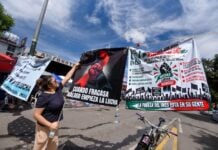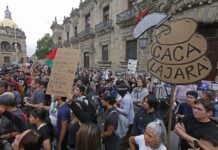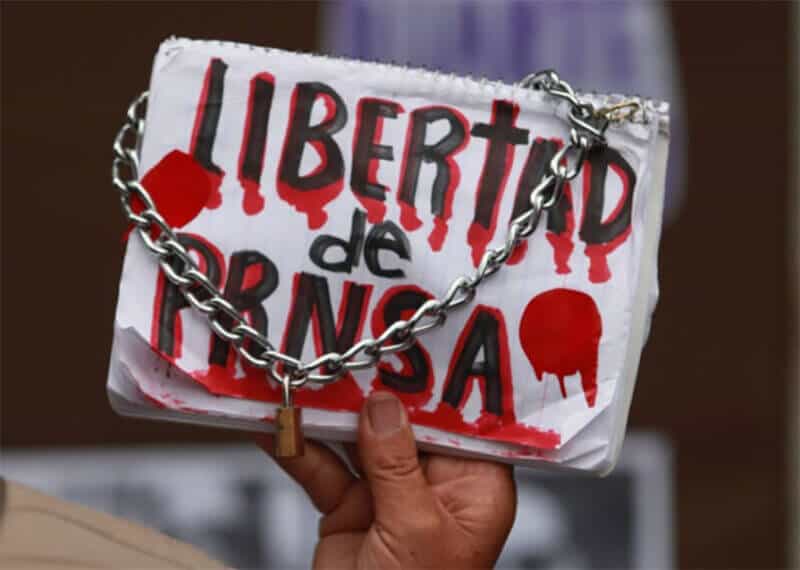
Mexico dropped five places on the latest edition of an index that measures freedom of the press and expression in Western Hemisphere countries.
With a score of 49.2 out of 100, Mexico ranked 16th out of 22 countries included on the Inter American Press Association’s Chapultepec Index 2021. It ranked 11th last year with a score of 55.
The only countries below Mexico were Guatemala, El Salvador, Brazil, Nicaragua, Cuba and Venezuela.
Based on more than 200 expert reports from the 22 countries, the index scores are derived from four different dimensions that measure the freedom of everyday citizens to express themselves: the freedom of journalists to do so; violence against journalists and the media, and the levels of impunity for such crimes; and government control of the media.
Mexico scored 11.57 out of 23 in the first dimension, 6.86 out of 10 in the second, 11.35 out of 42 in the third and 19.43 out of 25 in the fourth.
The Inter American Press Association (IAPA) said that Mexico’s rating in the third dimension – violence against journalists and the media – is “alarming,” noting that 12 Mexican journalists were murdered in its one-year assessment period, which concluded at the end of July.
President López Obrador’s frequent attacks on sections of the media create a “poisoned atmosphere” and risk inciting violence against journalists, according to Roberto Rock Lechón, general director of the news website La Silla Rota and president of the Committee on Freedom of the Press and Information at the IAPA.

The Mexico representative of the Committee to Protect Journalists said late last year that the president’s attacks on the media pose a threat to freedom of expression.
“The political climate in Mexico doesn’t encourage freedom of expression. When the government of Andrés Manuel López Obrador took office we saw some positive signs; for example, the commitment to put an end to impunity, censorship and the murder of journalists,” Jan-Albert Hootsen said.
“Unfortunately, almost two years later there is a climate of significant polarization, … a rhetoric of confrontation with the press [and] a division between good press and bad press,” he said.
Little has changed in López Obrador’s third year in office. In fact, the government’s vilification of the media may have worsened since it introduced its weekly fake news exposé sessions earlier this year.
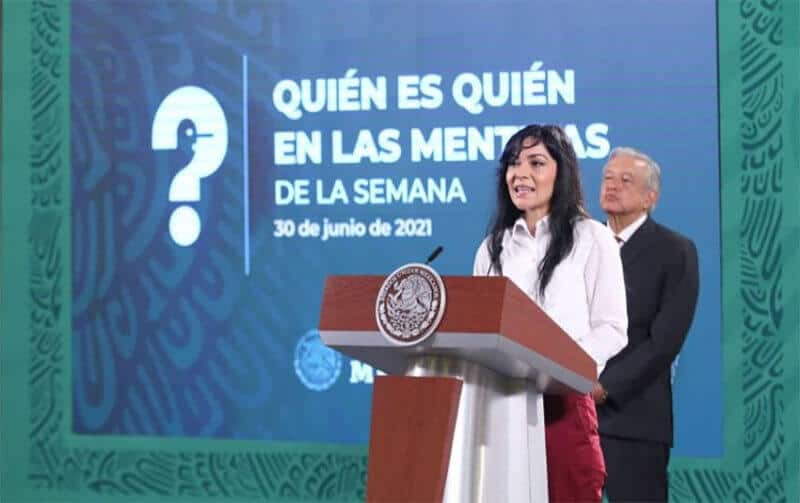
The president also expressed his disdain for the media in his recently published book.
“… The vast majority of media outlets, with their commentators, columnists, contributors and news presenters, have completely given themselves over to defamation and lies,” he wrote.
Mexico’s overall score on the Chapultepec Index is 6.4 points below the regional average. Mexico is part of a group of countries where there is “partial restriction” of freedom of expression, according to the IAPA. The other countries in the same group are Colombia, Ecuador, Argentina, Bolivia, Guatemala and El Salvador.
There is “high restriction” of freedom of speech in Brazil and no freedom of speech in Nicaragua, Cuba and Venezuela, the organization said.
Uruguay and Chile ranked first and second, respectively, on the index and are the only two countries where there are no restrictions on freedom of expression, according to the IAPA.
Ranking third to 11th were, in order, Jamaica, the Dominican Republic, Canada, Costa Rica, Peru, Paraguay, Panama, the United States and Honduras. There is “low restriction” on freedom of expression in those countries, the association said.
Mexico News Daily