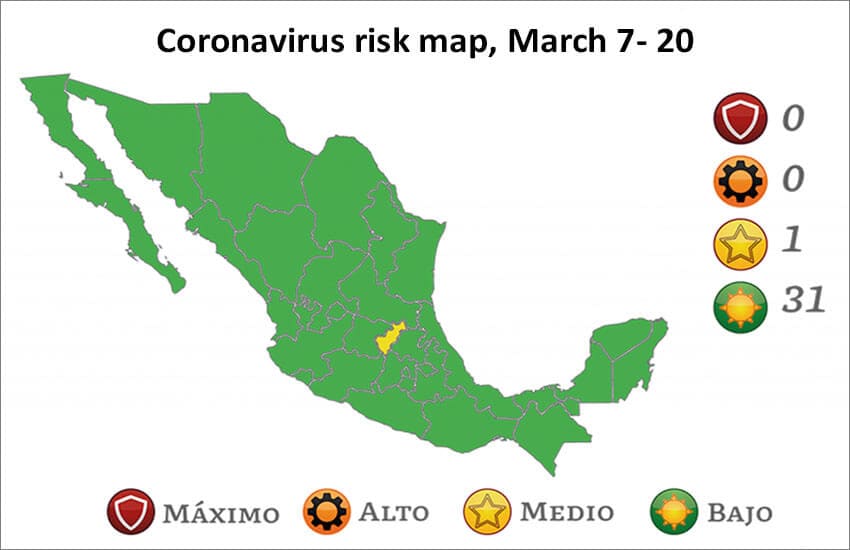
All but one of the 32 federal entities are low risk green on the federal government’s new coronavirus stoplight map as the fourth wave of the pandemic continues to recede.
Querétaro is the outlier, remaining medium risk yellow on the updated map, which takes effect Monday and will remain in force through March 20.
There were 16 yellow states on the previous map, but the risk level was downgraded in all but Querétaro, where there are just over 30 active cases per 100,000 people, according to the Health Ministry’s latest coronavirus report.
The Bajío region state ranks sixth in the country for per capita active cases behind Baja California Sur, Mexico City, Aguascalientes, Colima and Tlaxcala.
It has the fourth highest occupancy rate for general care beds in COVID wards, with 28% taken, and the second highest rate for beds with ventilators, of which 22% are in use.
The federal Health Ministry uses 10 indicators to determine the stoplight color in each state, including hospital occupancy levels, the effective reproduction rate of the virus, the weekly positivity rate and case numbers per 100,000 inhabitants.
Each stoplight color is accompanied by recommended restrictions to slow the spread of the virus but it is ultimately up to state governments to decide on their own rules. Authorities have lifted most restrictions on business and social activities as the omicron-fueled fourth wave wanes, but the use of face masks is still required in most indoor settings.

The last time Mexico had so many low risk states was the two-week period between November 15 and 28, when 31 were green and Baja California was high risk orange.
The entry into force of the latest almost exclusively green stoplight map comes as reported case numbers continue to decline.
An average of 9,393 cases per day were reported during the first six days of March, a 54% reduction compared to the daily average in February.
There are currently 30,652 estimated active cases across the country, whereas the number exceeded 300,000 at the peak of the fourth wave in January.
Mexico’s accumulated case tally increased to 5.56 million on Sunday with 1,905 new infections reported.
COVID-19 deaths increased sharply in February, with 12,058 reported, compared to 6,663 in January. An additional 1,710 fatalities were reported during the first six days of March for a daily average of 285. That’s a 34% decline compared to the average of 431 deaths per day in February.
Mexico’s official death toll rose to 319,859 on Sunday with 35 additional fatalities reported. The country ranks fifth in the world for total deaths, and 28th on a per capita basis with 250.5 per 100,000 people, according to data compiled by Johns Hopkins University.
More than 85.3 million Mexican adults have received at least one dose of a COVID-19 vaccine, the Health Ministry reported Sunday, while 4.7 million adolescents have also received shots.
Mexico’s population wide vaccination rate is 67%, according to The New York Times vaccinations tracker, with 62% fully vaccinated.
Authorities have also administered more than 28.3 million booster shots to people aged 30 and over, the Health Ministry said.
Younger adults are also eligible for boosters, but haven’t yet received them in most parts of the country.
Mexico News Daily