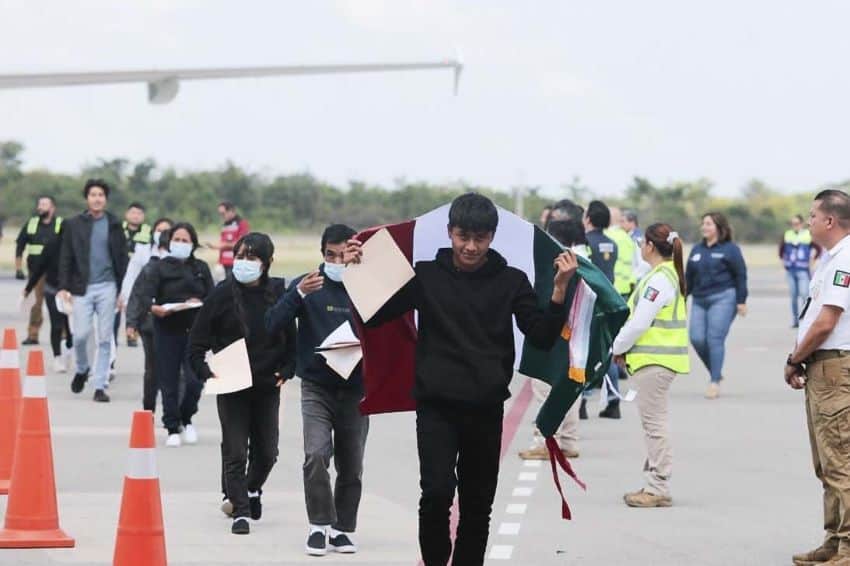
President Claudia Sheinbaum said Monday that Mexico has received almost 20,000 deportees from the United States since President Donald Trump took office.
Speaking at her morning press conference, Sheinbaum said that 19,663 people were deported to Mexico between Jan. 20 and March 2.
#EnLaMañanera | La presidenta Claudia Sheinbaum informó que desde el pasado 20 de enero, con el inicio de la administración de Donald Trump, han sido deportados 19 mil 663 migrantes de Estados Unidos hacia México. pic.twitter.com/7Y5dgZJfmZ
— El Financiero (@ElFinanciero_Mx) March 3, 2025
She said that 15,611 of the deportees — almost 80% of the total — are Mexican, while the remaining 4,052 are foreigners.
On Sunday, just 313 people were deported to Mexico from the United States, Sheinbaum said.
Based on the statistics the president provided, an average of 468 people per day were deported to Mexico from the United States between Jan. 20 and March 2.

Before he took office, Trump pledged to carry out “the largest deportation operation in American history.”
However, during the first six weeks of his second term, “the pace of deportations has held steady compared to last year,” CNN reported on Monday citing an analysis of deportation flight data.
Sheinbaum has expressed her opposition to Trump’s mass deportation plan on repeated occasions. She and other Mexican officials have frequently highlighted the importance of Mexican workers to the United States economy.

On Monday, Sheinbaum reiterated that 80% of Mexicans’ earnings in the United States remain in the U.S. via “the payment of taxes, savings and consumption.”
She said the other 20% are sent to Mexico as remittances, which totaled more than US $64 billion last year.
“Our compatriots help us, they help their families … but without them, the United States economy wouldn’t be what it is,” Sheinbaum said.
Government will assess the need for deportee reception centers at the end of the month
Sheinbaum noted that 10 reception centers, or temporary shelters, were set up in northern border cities as part of the government’s “México te abraza” (Mexico embraces you) program for people deported to Mexico during the second Trump administration.
“The truth is they’ve received few people,” she told reporters.
Sheinbaum highlighted that the government also provides access to temporary accommodation and the broader “México te abraza” program to deportees who arrive by air at different airports including the Felipe Ángeles International Airport north of Mexico city, the Tapachula airport and the Villahermosa airport.
Reception centers will remain in place “while repatriations continue,” she said, adding that at the end of March the government will evaluate whether it’s necessary to maintain the 10 on the northern border or whether “fewer” than that number are required.
Mexico News Daily