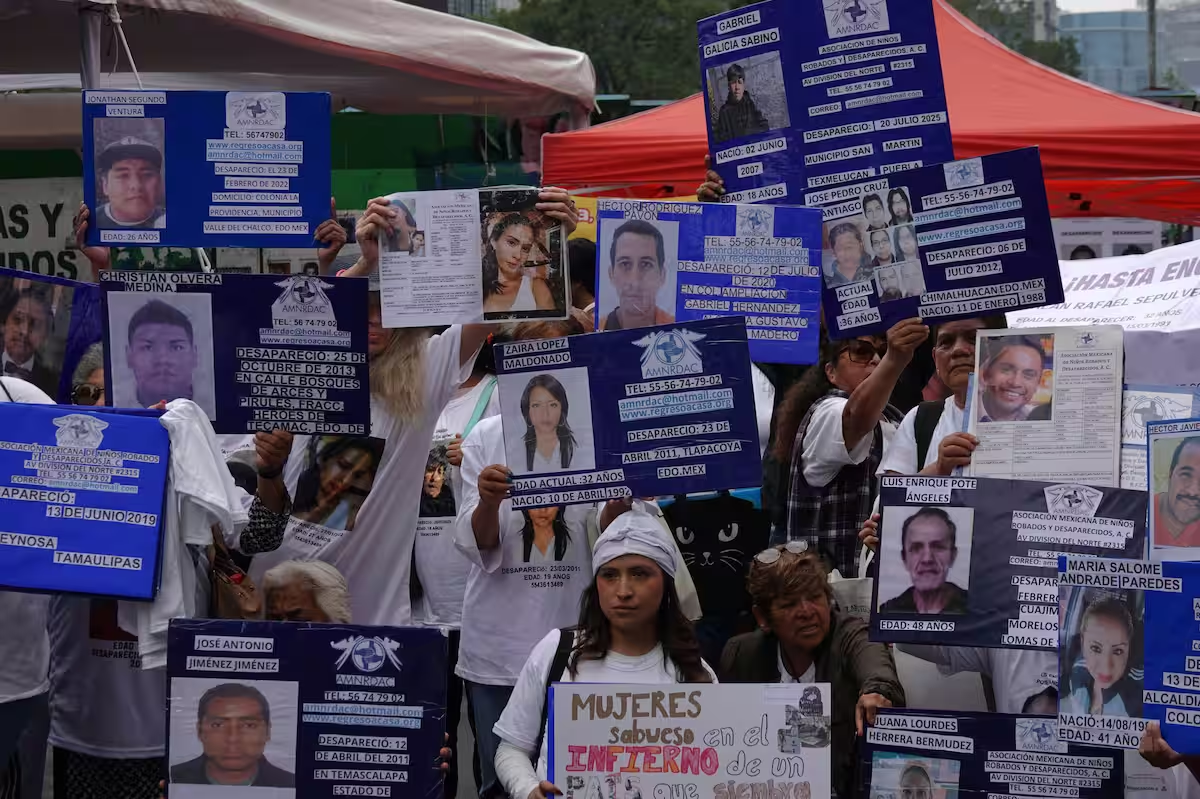
President Claudia Sheinbaum has praised a new report on the government’s search for missing persons, highlighting findings that 31% of the more than 132,000 people currently listed as disappeared might actually be alive.
However, the report also found that official investigations of more than 46,000 of those considered missing have yet to begin due to a lack of data.
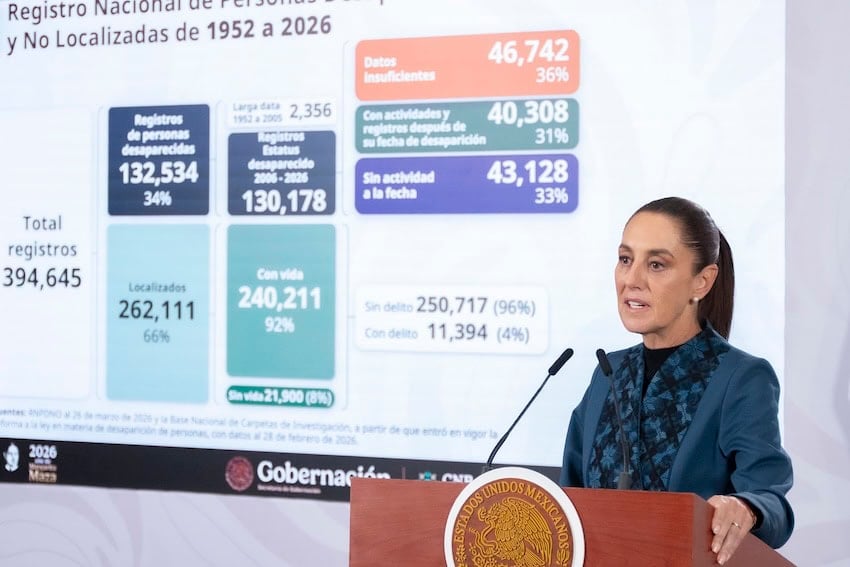
As part of the presentation, Sheinbaum provided an update on the search for missing persons, outlined progress made and challenges faced and explained strategies implemented since the beginning of her administration in October 2024.
“It is a comprehensive report that seeks to provide clarity on where we are and what actions we are taking,” she said, before turning the dais over to Marcela Figueroa, the executive secretary of the National Public Security System (SNSP).
Figueroa said the National Registry of Missing and Unlocated Persons carried out a year-long review of all the official data on the disappeared from 1952 through 2026.
“Of the 394,645 individual files in our possession, 262,111 have been located, of which 92% were located alive,” she said. “However, this means 132,534 people remain unaccounted for today.”
Of those 132,534 officially labeled as missing, 130,178 have been registered since 2006 when such disappearances began to surge after Mexico formally launched a war against drug cartels.

On the positive side, the SNSP review discovered that there was evidence of legal activity — such as tax filings, birth certificates or phone records — related to 40,308 individuals registered as missing.
“As a result, 5,269 people have been located and their status has been changed from missing to located,” Figueroa said.
With regard to the 46,742 cases that lack sufficient information to initiate a search, Figueroa explained that the existing reports do not include name, sex or date of birth, or lack sufficient detail related to the place or date of disappearance.
Figueroa attributed this issue to the absence of legal parameters for carrying out such registrations, a shortcoming that was addressed by the July 16, 2025, enactment of the General Law on Disappearances.
Even without the descriptive information, Figueroa said, all cases will remain registered with the SNSP. However, the 2025 reform now blocks entries without minimum data.
That leaves 43,128 cases (33% of those still missing) with complete data, but for whom the authorities found no record of activity via cross-referencing of official databases.
These cases are distinct from the 2,356 long-standing cases registered between 1952 and 2005.
All data reviewed was derived from SNSP records through March 26 this year, and from the National Database of Investigation Files records dating to Feb. 28.
The SNSP report further acknowledged that the registry was initially compiled by uploading unverified lists from federal and state prosecutors, search commissions, citizen reports and activist groups, which created duplications and incomplete entries.
Sheinbaum said Interior Minister Rosa Icela Rodríguez holds regular meetings with families of the missing and search groups, while also collaborating with the office in Mexico of the UN High Commissioner for Human Rights, which has provided support and technical advice.
Although activists such as Fernando Escobar of the NGO Causa en Común concede the government’s work is positive, he, and others, question the veracity of the data, especially in light of the recent and more frequent discoveries of clandestine graves.
“The true number of missing persons is becoming increasingly uncertain,” Escobar said.
The continuing rise in disappearances — 193 people have been reported missing this year in Mexico City alone — is also a concern.
With reports from Reuters, Infobae, La Silla Rota and Semanario Zeta