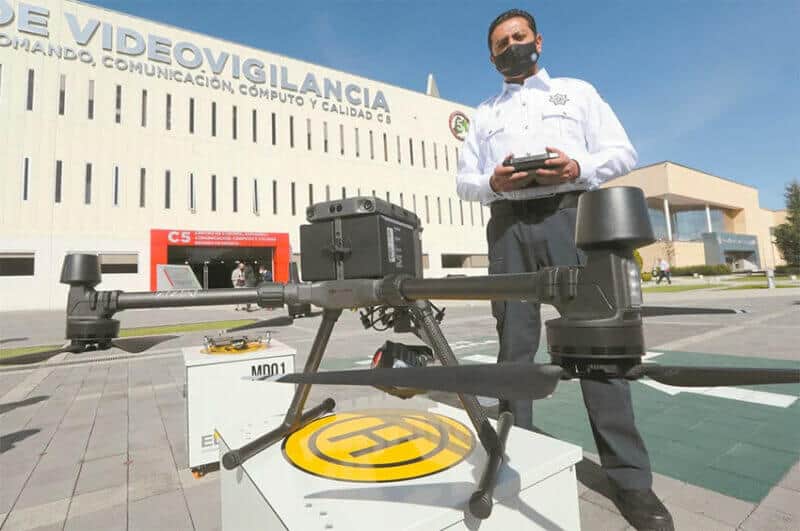
The use of drones to combat crime is proving to be a success in México state, where 109 of the devices are in operation.
The unmanned aerial vehicles have helped authorities detain thieves who target public transit users and pedestrians, locate missing people and track stolen vehicles, according to the deputy director of video surveillance at the C5 security center in Toluca.
Drones and other crimefighting technology such as security cameras have allowed authorities to identify and follow criminals as they escape from the places where they perpetrated their offenses, José Luis Amado Mauro told the newspaper El Universal.
“[The drones] have been very useful,” he said, explaining that they have carried out 8,736 flights of which at least 400 made a successful contribution to the fight against crime.
Amado said the drones are often used in hard-to-reach places such as gullies and ravines, adding that they have also been deployed in high-crime areas where carrying our patrols is risky for police.
The official said that México state authorities have used two different types of drones since early last year. One is the so-called “drone in a box” in which the aerial vehicle deploys from and returns to a self-contained landing box.
Amado said that 65% of the box drones are situated in high-crime areas that are part of the greater metropolitan area of Mexico City. There are three in Ecatepec, a municipality notorious for crime, and two in each of Naucalpan and Tlalnepantla. There are also two box drones in Toluca, the state capital.

Amado said the box drones were placed in areas where there are few security cameras. They are operated from the C5 security center, he explained.
The security official said that México state is one of the states with the highest number of crimefighting drones. He described the state, Mexico’s most populous, as a pioneer in their use.
Amado said authorities also used drones to assess a recent landslide at Cerro de Chiquihuite, a populous hill on the boundary between Tlalnepantla and Gustavo A. Madero, a Mexico City borough.
As a result of the use of drones, authorities were able to inform rescue workers about the conditions they faced, allowing them to work with greater precision and without risking their lives, he said.
With reports from El Universal