Mexico abstained from voting on a United States proposal for an emergency meeting of the Organization of American States (OAS) on how to respond to Nicaragua’s decision to bar opposition politicians from running for office.
Despite Mexico’s objections, the OAS on Wednesday approved a resolution summoning foreign ministers to an emergency council session by a lopsided 29-1 vote. The OAS is the leading international political forum for Western Hemisphere nations.
Brazil was the lone “nay” vote, while Haiti and Venezuela were absent. Nicaragua, which withdrew from the OAS in 2023, was also absent.
The resolution — which invokes Articles in the OAS Charter that demand a collective response — defines developments in Nicaragua as “a problem of an urgent nature and of common interest to the American States.”
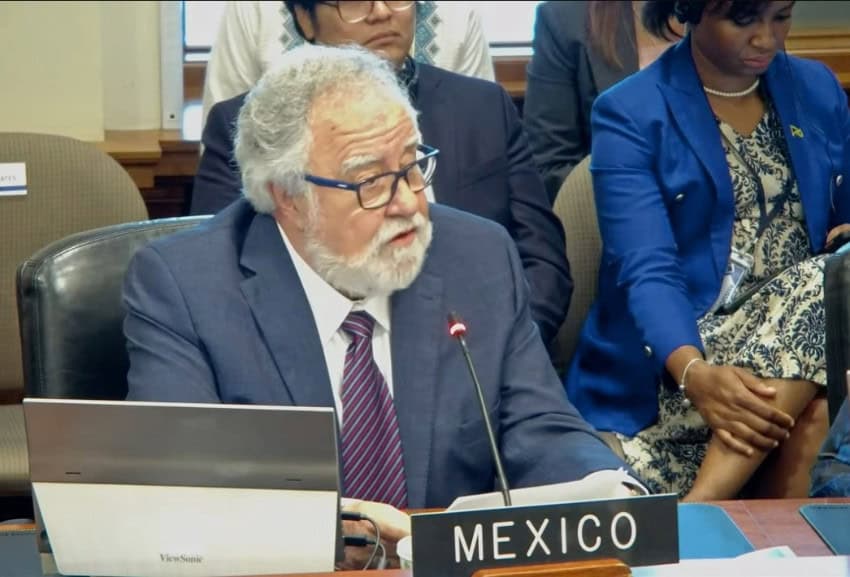
Alejandro Encinas, Mexico’s representative to the OAS, said Mexico does not consider it appropriate to characterize Nicaragua’s internal situation as a threat to regional peace or security.
He warned that doing so could open the door to actions that exceed the OAS’s authority, describing these potential actions as “incompatible with the principles of respect for sovereignty, self-determination of peoples, non-intervention and peaceful settlement of disputes.”
Encinas also argued that treating an internal political crisis as a security issue does not necessarily help resolve it. On the contrary, he said, it can generate confrontation, deepen isolation and lead to measures that hinder a peaceful solution and produce greater destabilization.

The OAS action came in response to Nicaraguan President Daniel Ortega’s vow to end elections and to promote constitutional amendments aimed at blocking opposition figures from power. Ortega announced the decision in July at the anniversary of the country’s Sandanista Revolution, which first brought him into power in 1979.
Argentina, Panama, Paraguay and Uruguay joined the United States in advancing this week’s measure — titled “Convocation of a Meeting of Consultation of Ministers of Foreign Affairs to Consider the Situation in Nicaragua” — at an Aug. 5 special session of the Permanent Council.
The U.S. insists the emergency meeting must take place before Sept. 1, when the Ortega regime is set to codify its latest policy reforms, including the suspension of future elections.
The OAS as a bloc cannot impose economic or trade sanctions on a country, limiting itself to diplomatic condemnation or suspension of a member state or recommending that its members punish a nation that violates democratic norms.
With reports from Animal Político, EWTN News, Al Jazeera and Buenos Aires Times