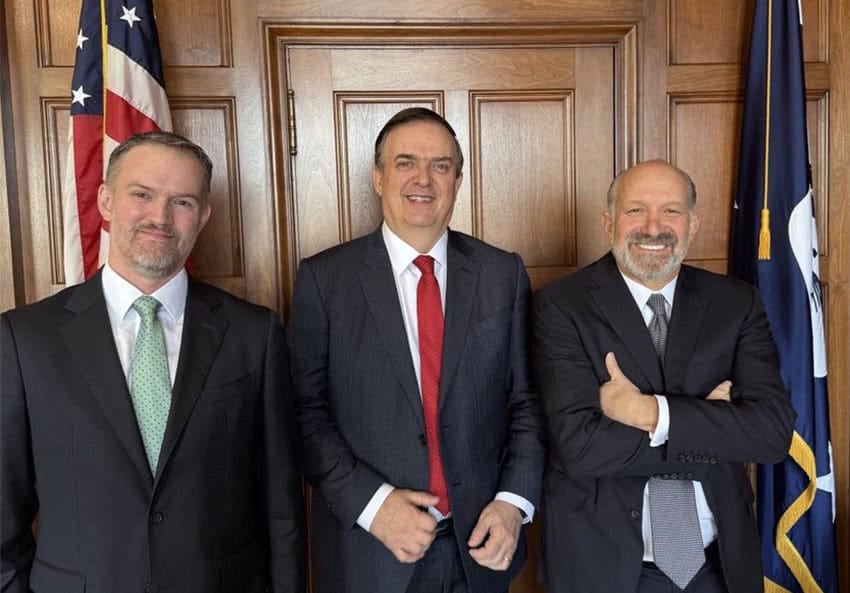
Mexico and the United States have agreed to begin formal discussions as part of the review of the USMCA free trade pact, the Office of the U.S. Trade Representative (USTR) said Wednesday.
The announcement came after U.S. Trade Representative Jamieson Greer met with Mexico’s Economy Minister Marcelo Ebrard in Washington, D.C.
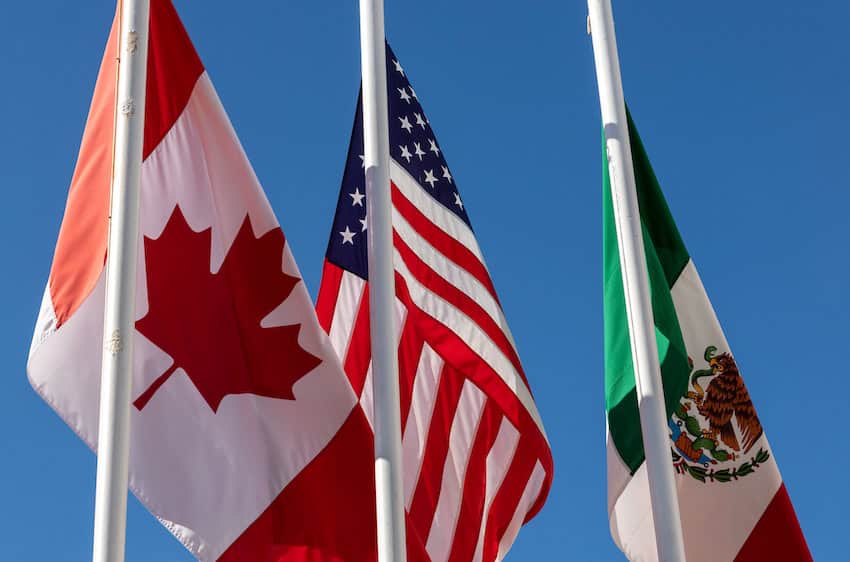
The USTR said the two officials met to “discuss bilateral trade relations and the upcoming USMCA Joint Review,” which Mexico, the United States and Canada must complete this year.
“Both sides recognized substantial progress in recent months and agreed to continue intensive engagement to address non-tariff barriers,” the USTR said.
“In addition, they agreed to begin formal discussions on possible structural and strategic reforms in the context of the first USMCA Joint Review, including stronger rules of origin for key industrial goods, enhanced collaboration on critical minerals, and increased external trade policy alignment to defend workers and producers in the United States and Mexico and to combat the relentless dumping of manufactured goods in our region.”
The USTR didn’t specify when the formal discussions would begin, nor did it say whether Canada would be involved in the talks.
Greer said late last year that negotiations during the USMCA review process would “probably” be more bilateral than trilateral.

His meeting with Ebrard came two weeks after Trump asserted that the USMCA provides “no real advantage” to the United States and is “irrelevant” to him.
“I think they want … [the USMCA], I don’t really care about it,” said Trump, who claimed that the United States doesn’t need goods from Mexico or Canada.
In October, Greer accused Mexico of failing to comply with the USMCA in a range of areas.
The U.S. trade representative has also said, per Reuters, that “the pact is not equipped to deal with surges of exports and investment from non-market economies such as China into the region.”
At the start of January, Mexico imposed new and higher tariffs on imports from China and other countries with which it doesn’t have trade agreements, whereas Canada — which now sees the U.S. as a less trustworthy partner — has decided to ease its duties on certain Chinese products. It remains to be seen how the two countries’ decisions will affect the USMCA review, but Trump has threatened to impose higher tariffs on Canada if it makes a broader trade deal with China.
Opinion: Mexico could lose out as Canada risks USMCA with bet on ‘new world order’
The U.S. president has railed against the United States’ trade deficits with Mexico and Canada, and accused Mexico of being a backdoor for Chinese goods bound for the U.S.
Trump has also criticized Mexico and Canada for not doing enough to combat the flow of drugs to the United States. Last March, he imposed 25% tariffs on non-USMCA compliant goods from both countries.
As Mexico seeks tariff relief and to safeguard its trade relationship with the United States, Mexican officials have engaged in ongoing trade talks with the U.S. officials during the entirety of the second Trump administration.
Ebrard has made frequent trips to Washington, D.C., and after his meeting with Greer on Wednesday struck an upbeat tone.
“We had a very good conversation with his team,” he said in a video message.
“… We spoke about … the next steps for the free trade agreement between our countries,” he said.
Avances de hoy en Washington: pic.twitter.com/MVtxvRkaQW
— Marcelo Ebrard C. (@m_ebrard) January 28, 2026
“As you know, it has to be reviewed this year. We’ve already made progress on many issues so that the review is carried out as quickly as possible and goes as well as possible,” Ebrard said.
He said that he spoke about tariffs with Greer, about “how the auto industry is evolving,” and about other issues related to trade between Mexico and the United States.
The economy minister also said they spoke about “critical minerals and the security of supply chains.”
“… I think it was a very good meeting to start the year,” said Ebrard, who later on Wednesday discussed trade and investment with U.S. Secretary of Commerce Howard Lutnick.
In addition to imposing tariffs on non-USMCA compliant goods, the Trump administration last year imposed duties on a range of other imports from Mexico including steel, aluminum and light and heavy vehicles. Nevertheless, the majority of Mexican goods can still be shipped duty-free to the U.S., which is easily Mexico’s largest trade partner.
Despite Trump’s remarks about the USMCA, President Claudia Sheinbaum remains confident that the trilateral pact will endure.
Even if Mexico, the United States and Canada don’t agree to extend the USMCA during the upcoming review process, it would not be terminated until 2036.
The agreement was negotiated during Trump’s first term as president and superseded NAFTA in 2020. It governs North American trade worth around US $2 trillion per year.
With reports from La Jornada and Reuters