The Mexican government on Friday said that for the first time in history, more Mexicans are categorized as middle class than as living in poverty.
Jesús Ramírez, director of President Claudia Sheinbaum’s Council of Advisers, also said that based on World Bank data the Mexican middle class grew by more than 12 percentage points between 2018 and 2024.
“These figures coincide with [our own] data indicating a reduction in poverty,” Ramírez said, referencing the August national statistics agency [INEGI] report that poverty was reduced from 41.9% of the population in 2018 to 29.6% by last year.
The August INEGI report found that the number of Mexicans living in poverty declined from 51.9 million in 2018 to 38.5 million in 2024.
In a social media post, Ramírez said the social policy championed by the Fourth Transformation political movement (4T) helped Mexico’s middle class increase by the greatest percentage among Latin American nations.
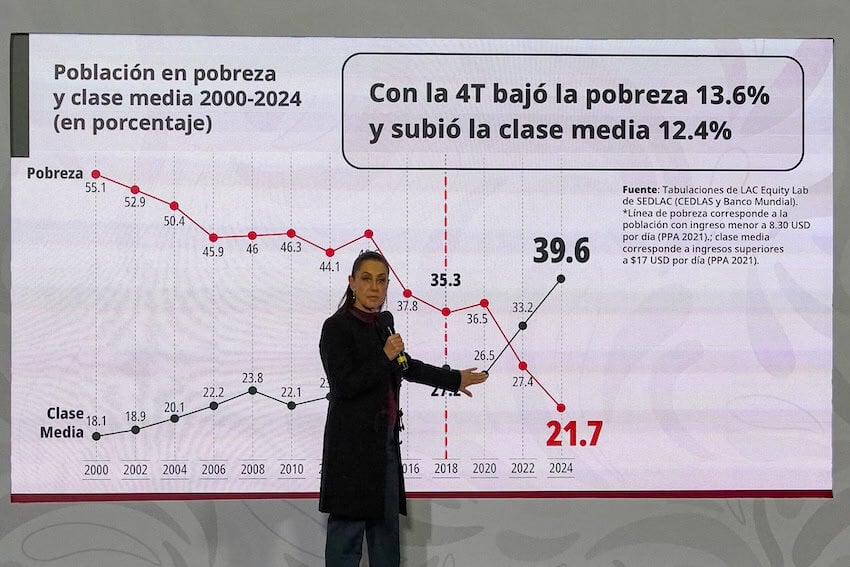
“Poverty decreased by 13.6% and the middle class … grew from 27.2% to 39.6%,” he wrote.
Ramírez said the World Bank report indicated that approximately 12 million Mexicans rose to middle class status during this period, which “coincides with the rise to power of the Fourth Transformation (4T) movement.”

Sheinbaum’s predecessor as president and the founder of the 4T, Andrés Manuel López Obrador, took office in December 2018.
The World Bank data on which Ramírez based his report comes from an October 2025 World Bank study titled “Regional Poverty and Inequality Update, Latin America and the Caribbean.” It found that Mexico and Brazil were the Latin American countries whose middle class grew the most since 2018.
The World Bank confirmed that Mexico has reduced poverty in recent years, although “at a slower pace than other countries with similar characteristics.” However, it said the eradication of extreme poverty in Mexico can be a clear public policy objective.
Additionally, the World Bank’s 2025 outlook sees Mexico continuing its path to being an upper-middle-income nation, but can expect “ongoing challenges in poverty reduction and inequality, requiring strategic investments and inclusive policies to truly broaden its middle class.”
Citing World Bank data, Ramírez said that in 2018, 35.5% of the Mexican population was below the income poverty line, while by 2024 that percentage had decreased to 21.7%.
The reduction in poverty produced unprecedented growth in the middle class, Ramírez said, boosting it from 27.2% of the population in 2018 to 39.6% in 2024.
“As a result, for the first time in Mexico’s history, the number of people in the middle class is greater than the number of people living in poverty,” he said.
The strategy of investing at the base of the pyramid not only resulted in the growth of the middle class, but also had positive effects on the overall economy, boosting consumption, business profits and financial activity.
“This proves that our economic and social policies not only lifted millions of people out of poverty, but also raised the living standards of other segments of the population and benefited society as a whole,” he said.
For her part, Sheinbaum attributed the nation’s progress to the 4T and what she called the movement’s belief in “a humanist government.”
“It’s called a moral economy, welfare programs, rights — not assistance programs, but rights,” she said.
In presenting the data, Ramírez said that the World Bank considers people with daily incomes above US $17 (around 340 pesos) to be middle class. Those earning less than that are considered to be living at various levels of poverty, down to extreme poverty.
With reports from El Economista and La Razón