Migrant-smuggling networks believed widespread in Mexico

The National Immigration Institute (INM) is investigating 20 internationally active migrant-smuggling networks believed to be operating in Mexico.

“These criminal networks take advantage of people’s transport needs to charge them amounts that can rise above 200,000 pesos (US $10,600) per person,” the institute said in a press release issued on Sunday.

The networks provide transportation and shelter for the primarily Central American migrants to reach their destination, most often the United States, offering up to five attempts.

The office said that it is committed to fighting such cases of people smuggling, as well as maintaining a safe, ordered and stable migration system.

The first migrant caravan of the year reached the Mexico-Guatemala border on January 20. Around 3,000 mainly Honduran migrants were stopped at the international bridge at Ciudad Hidalgo, Chiapas.
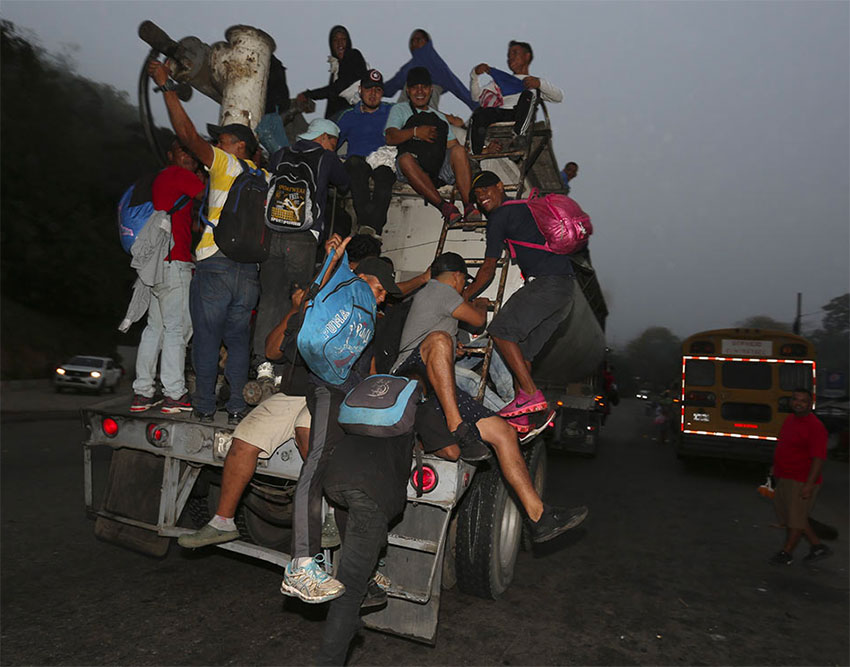
Migrants cling to a truck as they attempt to head into Mexico.

The National Guard then used batons and tear gas to repel hundreds of migrants who crossed the Suchiate River in an attempt to enter the country.

President López Obrador said days later that the migrants had been rounded up to protect them from criminal gangs.

Despite the government’s efforts to hold the migrants back at the border, as many as 1,000 crossed into Mexico on Thursday, marching over seven kilometers toward Tapachula, Chiapas, before being blocked by National Guard troops who fired tear gas at them.

As many as 1,000 migrants entered the country legally on the weekend and were taken to migration facilities. Although their cases for asylum or employment are being evaluated, authorities said that the majority of them will be deported.

As of Monday, the immigration institute had deported more than 2,000 migrants from the so-called Caravan 2020 in nine days.

And according to reports yesterday, immigration agents will be busy once again at the end of the week. The self-designated Devil’s Caravan is expected to bring more migrants Friday from El Salvador.

Source: El Sol de México (sp)

Have something to say? Paid Subscribers get all access to make & read comments.
Manzanillo, Colima, México, 13 de marzo de 2026. La doctora Claudia Sheinbaum Pardo, presidenta Constitucional de los Estados Unidos Mexicanos en conferencia de prensa matutina, “Conferencia del Pueblo” desde Colima. La acompañan Indira Vizcaíno Silva, gobernadora Constitucional del Estado de Colima; Omar García Harfuch, secretario de Seguridad y Protección Ciudadana (SSPC); Raymundo Pedro Morales Ángeles, secretario de Marina (Semar); Bulmaro Juárez Pérez, divulgador de lenguas originarias, presentador de la sección “Suave Patria”; Ricardo Trevilla Trejo, secretario de la Defensa Nacional (Sedena); Jesús Antonio Esteva Medina, secretario de Infraestructura, Comunicaciones y Transportes; Bryant Alejandro García Ramírez, fiscal general del Estado de Colima; Fabián Ricardo Gómez Calcáneo; Rocío Bárcena Molina, subsecretaria de Desarrollo Democrático, Participación Social y Asuntos Religiosos de la Secretaría de Gobernación; Efraín Morales López, director general de la Comisión Nacional del Agua (Conagua); Marcela Figueroa Franco, secretaria ejecutiva del Sistema Nacional de Seguridad Pública (SESNSP) y Guillermo Briseño Lobera, comandante de la Guardia Nacional (GN). Foto: Saúl López / Presidencia

Mexico’s week in review: Congress deals Sheinbaum her first legislative defeat

0
The week of March 9 in Mexico was marked by standoffs between allies in Congress and adversaries at the airport. Here's what you missed.
A soldier displays seized handguns

The US and Mexico, growing together and growing apart: A perspective from our CEO

0
From a historic drop in homicides to opposite bets on electric vehicles, Mexico News Daily's CEO breaks down where the U.S. and Mexico are converging — and where they're not.
Veracruz Gov.

Veracruz governor blames private vessel for 200-kilometer Gulf Coast oil spill

1
The spill, which has spread to over 200 kilometers of Mexico's Gulf Coast beaches, has been traced to a private oil tanker off the coast of Tabasco.
BETA Version - Powered by Perplexity