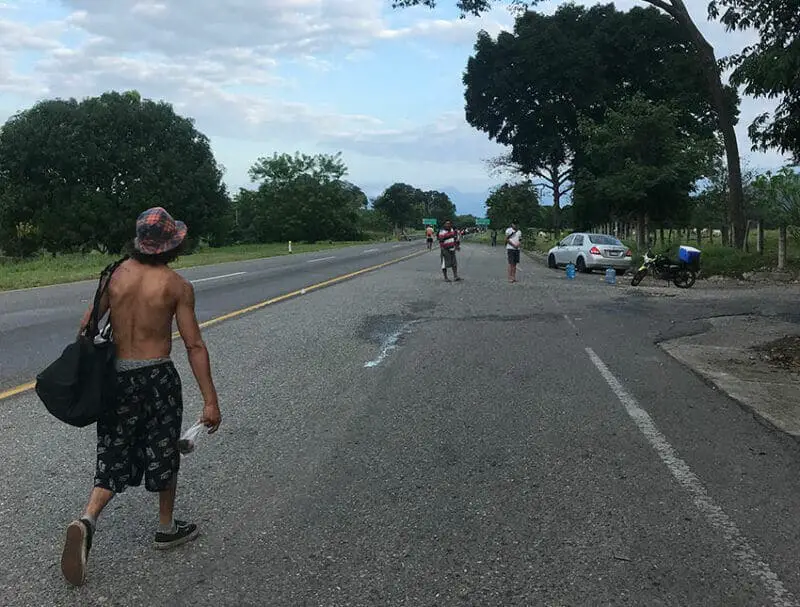
The leaders of the migrant caravan that left Tapachula, Chiapas, on October 23 have rejected a proposal by immigration officials to provide some of the migrants with visitor cards.
They were also offered transportation to other locations to regularize their immigration status.
National Immigration Institute (INM) personnel met with caravan representatives on Friday in Acacoyagua, the town where the roughly 2,500-strong caravan arrived after walking 3.6 kilometers from Escuintla, where they spent Thursday night.
Two large buses, pickup trucks and National Guard officers were on hand in Acacoyagua, presumably to transport the migrants, journalist Chasper Senn said.
The INM said in a statement that it had offered visitor status to women and children and transportation of the migrants to various states to process applications to regularize their immigration status. Food and shelter had also been offered, it said.
But it remains unclear if all the migrants would be eligible for resettlement in other states. Caravan organizer Luis García Villagrán said those who accepted the INM’s proposal would have been transferred to Querétaro, Guerrero, Puebla, Oaxaca, Hidalgo or Morelos.
He and fellow organizer Irineo Mújica said the migrants expected to be regularized where they are, rather than being transferred to another state, the news site Infobae reported.

When the migrants assembled, a majority voted with a show of hands and triumphant cries that the caravan should continue.
The INM said in a press release that it was impossible to update the migratory status of those in the caravan in Chiapas. “Operationally it isn’t possible due to the technological resources in the offices.”
“It is necessary to question the responsibility involved in leading migrants on a march in adverse temperature conditions, with a lack of safe spaces to spend the night and physical exhaustion, especially in the presence of pregnant women, … boys and girls,” it added.
The migrants’ trust in authority is low. Many were sent to prison-like detention centers run by the INM when they entered Mexico, some for months. Their migratory applications to the refugee agency COMAR and the INM have largely gone unresolved. When they left Tapachula they were met by National Guard officers in riot gear who tried but failed to block their path.
Moreover, many have left their countries due to their mistrust in corrupt governmental institutions, and had to pay multiple bribes to immigration authorities in the countries they passed through on the way to Mexico.
Some said they were unable to take the INM at its word. “Immigration wants to take us to Tapachula or send us to the country of origin,” said Honduran Lorena Rodríguez, who is traveling with her husband and their baby.
“We’ve sacrificed so much” to get this far, she said.
Others expressed concern that even if they were transferred to another state, the quality of attention from the INM might not improve.
On Friday evening, the convoy walked another 13 kilometers to Ulapa, where they set up camp.
There are fears among the caravan that the INM and National Guard are waiting in large numbers to confront them on the way to Mapastepec, 15 kilometers north.
UPDATE: This story has been updated with a clarification of the proposals offered by the INM.
Mexico News Daily