The migrant caravan traveling north from Tapachula, Chiapas, hiked 17 kilometers to Villa Comaltitlán on Wednesday after making slow progress due to an unusually large contingent of pregnant women and children. Organizer Irineo Mújica confirmed that most caravans reach Huixtla on the first day: this time it took three days.
The convoy assembled at 5:30 a.m. Wednesday outside Huixtla’s Catholic church. Many migrants spent Monday night at a cramped sports facility, but were transferred Tuesday to the streets outside the church, where women and children were provided shelter.
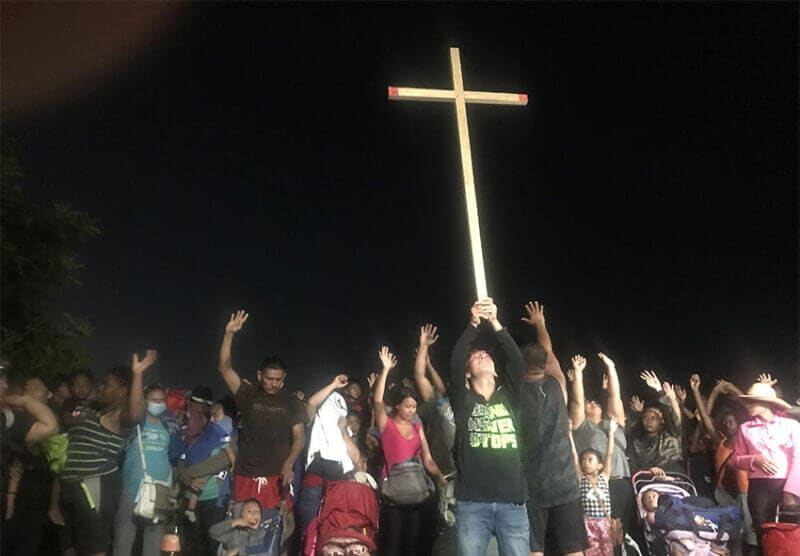
Mújica prevented the caravan from leaving Huixtla until the trash on the streets was cleared. He then led a prayer, with each line called back by the crowd: “Our father, we are leaving from this town … touch the hard hearts of the politicians … don’t criminalize our liberty … a government that demands respect but imprisons you without conscience … and the women and children too, who are condemned to live in the streets, to suffer from hunger … [the government] is taking its dollars stained in blood,” he said.
The caravan approached a National Immigration Institute (INM) checkpoint some three hours later, where the migrants halted, fearing repercussions. After a short standoff, the convoy surged forward unopposed and the barrier was raised, sparking celebrations and cries of “Freedom! Freedom!”
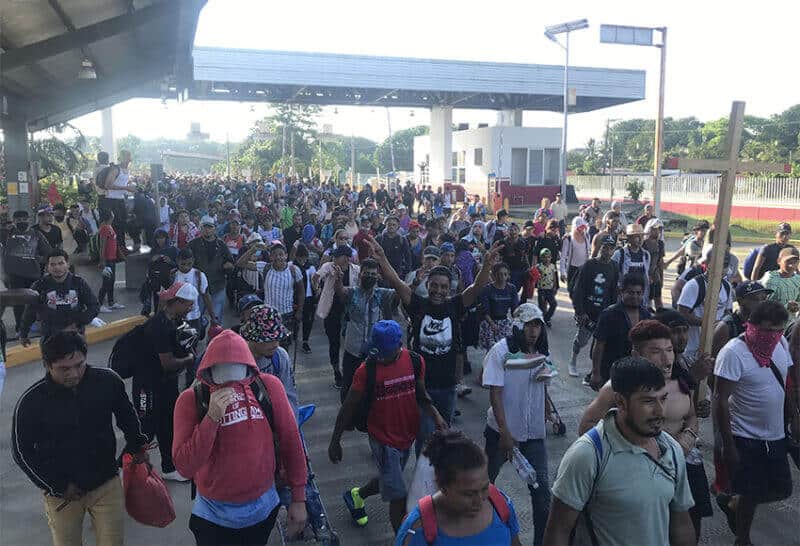
Soldiers, immigration officials and private security guards admired the spectacle of the enormous crowd, taking photos and videos on their phones as it passed the checkpoint barrier, about 10 kilometers north of Huixtla.
A private security guard named Eric who worked at the station said he was on the side of the migrants. “They should be free to transit … so that their dreams can be realized,” he said.
Numerous travelers collapsed on the highway under particularly intense heat, with temperatures above 38 C, the news agency EFE reported. There was only one Health Ministry ambulance available to serve at least 2,000 people, although organizer Luis Rey García Villagrán quoted a much higher total of 4,000 migrants, 1,250 of which were minors, he said.

The organizers instructed the convoy to pause about four kilometers from their destination, where they rested under mango groves for a few hours before arriving at Villa Comaltitlán around 5 p.m.
Here they were met with an unexpected welcome — the corpse of an unidentified man lying in the park where they set up for the night. But municipal police officers removed the body from the park, where most of the convoy stayed, while others were housed by a Catholic church after it opened its doors to women and children.
Rights organizations such as the United Nations High Commissioner for Refugees (UNHCR) and the United Nations International Organization for Migration (IOM) appear to have left the convoy; representatives from the Mexican Human Rights Commission (CNDH) and INM medics were present in Villa Comaltitlán, but not readily available on the highway. Chiapas rural health organization Mother Earth Mexico provided medical attention and water at the entrance to Villa Comaltitlán.
Mexico News Daily