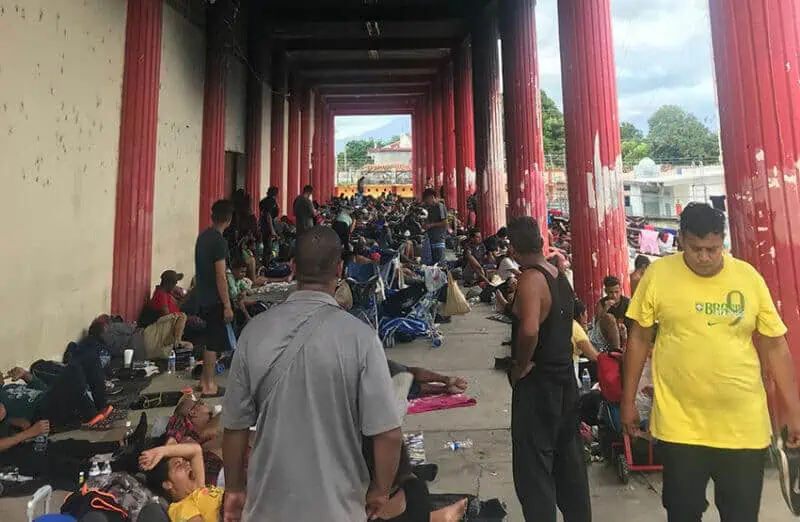
The migrant caravan traveling north through Chiapas moved another 17 kilometers to Escuintla on Thursday. The group, which may include as many as 2,500 people, arrived in the town around midday and planned to continue north Thursday evening, but were hampered by heavy rain. They stayed in the uncovered central park and in an auditorium that was opened by municipal authorities.
The convoy left well before daybreak Thursday morning and quickly became widely dispersed: something that organizers have worked hard to prevent. However, on this stretch there were no immigration checkpoints, which may have alleviated concerns.
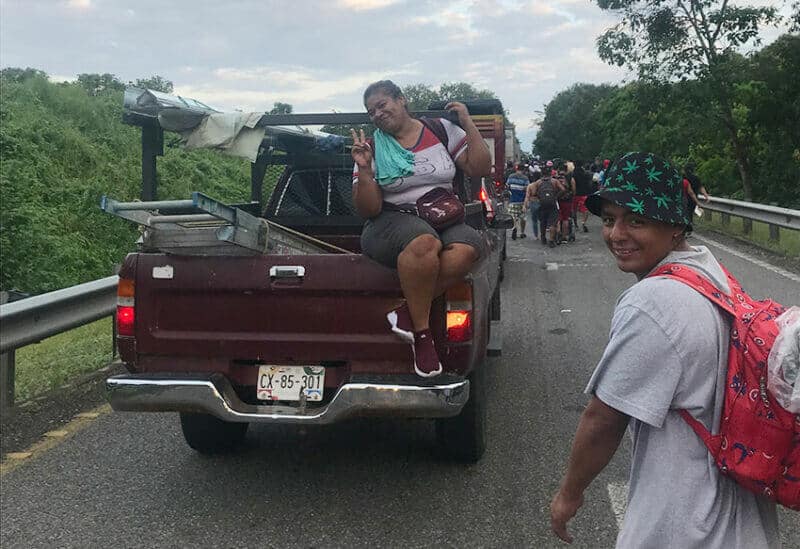
The migrants are sleeping poorly — as little as four hours per night — and are eating infrequently. Exhausted, many employed pickup trucks and the back of trailers to hitch a short ride up the highway.
About halfway to Escuintla, the terrain changed from a valley to a more compact, thickly treed, jungle-like environment. The sounds of flowing water, tropical birds and insects accompanied the travelers.
Heavy rain commenced about one hour before their planned departure at 5 p.m. for Acagoyagua, 3.6 kilometers north. Organizer Irineo Mújica said the rain was the obstacle, but rumors in the caravan were that authorities in Acagoyagua had worked to prevent the migrants from setting up camp there.
The multinational group is traveling north for a host of reasons, which are often consistent within nationalities, but generally vary across borders.
Junior, a sports teacher from Juventud Island in Cuba said he left the country in 2019 due to political repression.

“I left Cuba because of the dictatorship. I wasn’t in agreement with the government in my country. I was being watched in the area near my home just for thinking differently,” he said.
He went to South America, before traveling north. In Colombia he and his wife reached the Darién Gap, an inhospitable, dangerous, ungoverned area that leads to Panama.
“The terrain is dangerous, the people are dangerous. There is an indigenous group that assaults people, rapes women and kills people … they demand money and white women, specifically Cuban women and Venezuelan women … we saw seven dead people including a child,” he said.
Alfredo García from Choloma, Honduras, said he was forced to flee due to a threat against him.
“I’m from a neighborhood where drugs are sold … my two children are still there with their mother. Two guys arrived at my house recruit me [to a gang]. I asked them for two days to consider it … I left at 4 a.m. the next day,” he explained, while pushing a friend’s child in a stroller.
“They wanted me to sell drugs for them because I know the place well and I was born there … they were starting to move in … [The gang] killed various friends of mine, they killed my cousin … My father had to leave the house because they came back to ask for me,” he added. “I want to go to the United States to help my family to keep moving forward … I’ll work in anything: construction, sweeping up, anything for a better future.”
Nicaraguan brothers Jayson and Francisco pointed to economic strife as their push factor.
“You give a lot of time and you invest a lot of money and it doesn’t get you anywhere,” said Jayson, who worked in photography, film and design.
“You’re always sowing and harvest never comes. You’re always giving, giving, giving, and you never get anything back,” Francisco said.
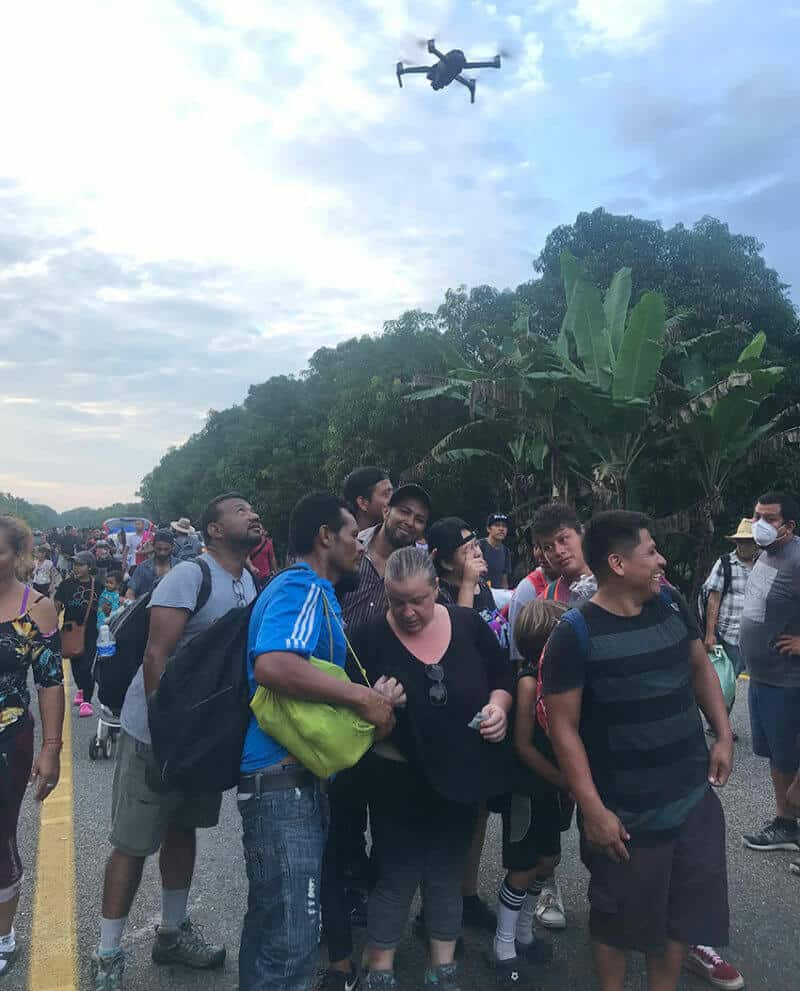
Numerical information about the caravan varies widely. Sources from an international organization that is monitoring the convoy said it estimated there are 2,000-2,500 migrants, of which at least 22 are pregnant women and at least 500 are under 18 years old. However, organizer Luis García Villagrán said his count recorded 5,000 migrants, more than 1,650 under-18s, and 63 pregnant women.
The National Immigration Institute (INM) said Wednesday it would provide humanitarian cards for pregnant women in the caravan, but medics working for the INM expressed doubt that the women would accept them. They said the cards would probably expand their right to work in southern states, but wouldn’t guarantee freedom of transit.
Mexico News Daily