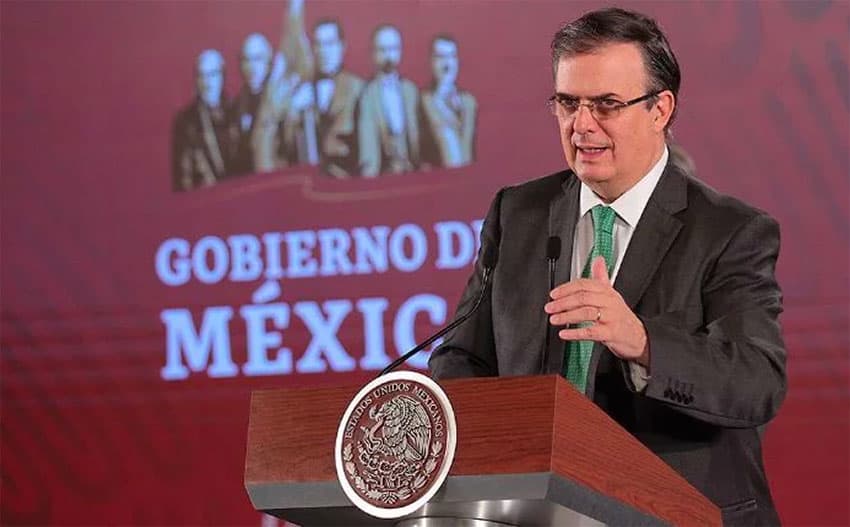
The government reduced migration through Mexico to the United States border by 56% between May and August, Foreign Affairs Secretary Marcelo Ebrard said on Friday.
Ebrard told reporters at the presidential press conference that the reduction in the number of migrants “is a result of diverse measures that the government has taken in compliance with Mexican immigration law.”
They include the deployment of the National Guard to step up enforcement against undocumented migrants, a measure to which Mexico agreed in June as part of a deal with the United States to end a threat to impose tariffs on all Mexican goods.
The number of people detained by the U.S. at its southern border dropped from 144,266 in May to 63,989 in August, according to information presented to reporters.
Ebrard said that 25,451 National Guardsmen have been deployed to the north and south of the country to stem the flow of undocumented migrants, highlighting that there have only been seven official complaints about their operation.
“The National Guard has participated in a very distinguished way . . . We only have seven complaints at the [National] Human Rights Commission. In other words, it’s a successful deployment,” he said.
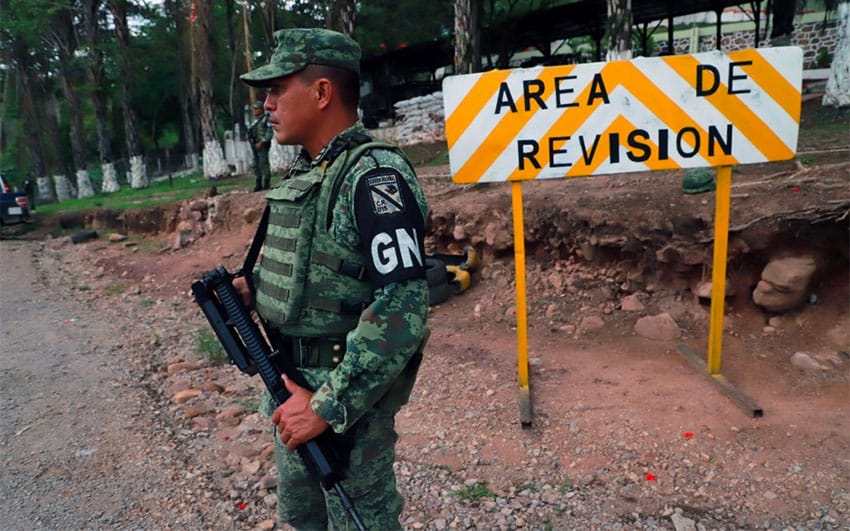
Ebrard said that 2,186 migrants traveling in semi-trailers towards the northern border have been “rescued” and that more than 1,000 people have been charged with human trafficking or people smuggling offenses.

The foreign secretary also spoke about the implementation of Mexico’s development plan in Central America.
With limited resources, Mexico has shown that jobs can be created in countries such as Honduras, Guatemala and El Salvador, Ebrard said. Job creation “is better than any other policy” to reduce migration, he added.
President López Obrador pledged in July to give US $90 million a year in development aid to the three Northern Triangle countries of Central America, where Mexico is supporting reforestation programs that are expected to generate tens of thousands of jobs.
López Obrador has consistently argued that stimulating economic and social development in Central America and southern Mexico is the best way to reduce migration to the United States.
Ebrard, who will discuss Mexico’s efforts to curb migration with United States officials in Washington D.C. next week, said the government is committed to supporting development in the region long term.
“Mexico will continue this strategy. I don’t expect a [new] tariff threat because there is a [migration] reduction of 56%. We urge the government of the United States to support Mexico’s [development] strategy,” he said.
Speaking to reporters on Wednesday, President Trump thanked Mexico, the Mexican government and the “great president of Mexico for helping us” to reduce migration.
“They’re helping us in a very big way. Far bigger than anybody thought even possible,” he said.
As part of the bilateral agreement struck in June, Mexico also agreed to accept the return of all asylum seekers that passed through the country as they await the outcome of their claims in the United States.
Official U.S. data on illegal crossings at the Mexico-United States border will be released next week, acting Homeland Security Secretary Kevin McAleenan said.