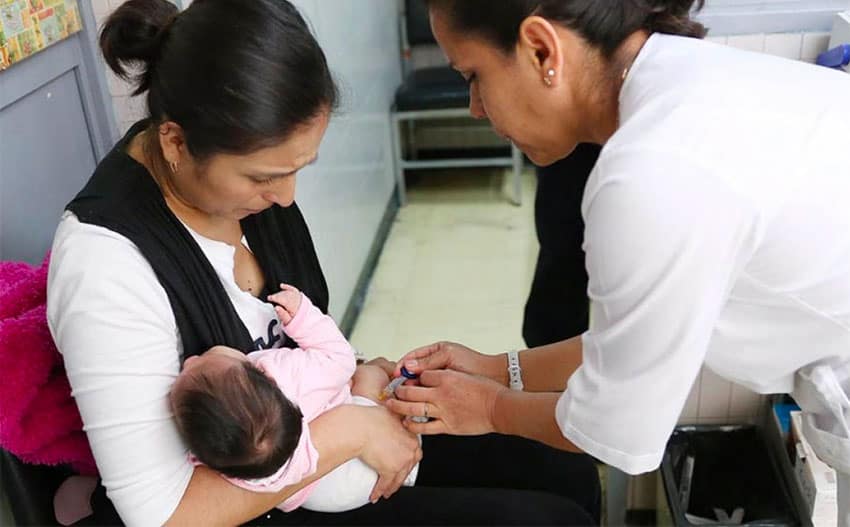
Deputy Health Minister Hugo López-Gatell has rejected a study that found that more than 1.6 million children were unable to access essential vaccines between January and October.
A study by the Mexican Vaccination Observatory found that just under 1.66 million children in six states – Durango, San Luis Potosí, Querétaro, Guanajuato, Hidalgo and Campeche – didn’t get the vaccines they required for a range of diseases including measles, hepatitis, diphtheria, polio and tuberculosis.
Of that number, 87% weren’t inoculated because the hospital or health clinic to which they went didn’t have the vaccines.
Asked about the study at a press conference on Sunday, López-Gatell claimed that the data was out of date.
However, he acknowledged that there have been problems with the national vaccination program, asserting that the government is today “trying to rebuild on the damage done, particularly between 2015 and 2018.”
The deputy minister said the government “inherited great vices” from its predecessor, asserting that it purchased vaccines from bogus companies set up for corrupt purposes.
“Some of these companies were barred [from selling vaccines] due to multiple irregularities. By being barred they left a void,” López-Gatell said.

“… The vaccines against tuberculosis and DPT [diphtheria, pertussis and tetanus] were the most affected. Also the vaccines against measles at one point,” he said.
López-Gatell said the government is currently purchasing the three vaccines from different producers around the world.
He said the Mexican government has been buying vaccines from the Serum Institute of India for 30 years without problem except for the 2015-18 period when fraudulent intermediaries got involved in the process.
In addition to the apparent shortage, many babies and children have missed out on essential vaccines this year because their parents didn’t take them to healthcare facilities out of fear of contracting the coronavirus, the newspaper Reforma reported.
Rafael Lozano, director of health systems at the Institute for Health Metrics and Evaluation at the University of Washington said that problems with Mexico’s network of infrastructure to keep vaccines cold have also caused people to miss out on getting essential shots.
López-Gatell said last week that Mexico wouldn’t purchase the Pfizer coronavirus vaccine – which the company announced is more than 90% effective – because it doesn’t have sufficient infrastructure to keep millions of doses frozen as required.