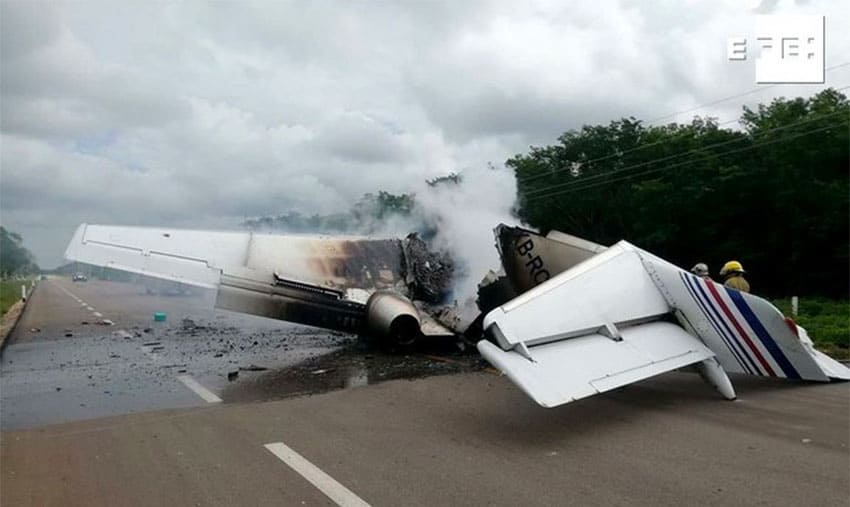
A plane authorities say was carrying over 100 million pesos’ worth of cocaine made an abrupt forced landing Sunday morning on a state highway in Quintana Roo after being tracked by the Mexican air force.
The occupants of the plane escaped capture and are being sought by security forces.
Shortly after the plane landed, military special forces deployed in a helicopter to pursue the plane’s crew confiscated a pickup truck carrying 390 kilograms of cocaine with an estimated a value of 109 million pesos (US $4.87 million) near the town of José María Morelos. Authorities say it was the plane’s cargo.
By the time military personnel reached the plane, which had landed in the municipality of Chunhuhub, it had been set on fire and the crew had presumably escaped into the nearby forest, authorities said. Quintana Roo Security Minister Alberto Capella posted a tweet asking residents to vacate the area where the plane had been found. His post showed videos of the plane in flames.
It was not the first such forced landing in Quintana Roo of a drug-trafficking plane. In January, military personnel seized cocaine and guns from two different planes only a day apart from each other. One landed in an airfield in Mahahual and the other on a highway in Chetumal.
Air force officials told the newspaper Milenio Sunday that it began tracking the Hawker 700 aircraft’s route soon after it took off around 5:00 a.m. CT from an airstrip south of Maracaibo, Venezuela. The plane, authorities said, had no flight plan and was not using a transponder, fitting the profile of a “clandestine aircraft” used for smuggling.
Once the plane entered Mexican airspace via the Yucatán Peninsula, military forces dispatched a T-6C Texan aircraft to intercept the Hawker and ordered it via radio three times to follow them to a military airbase in Cozumel. The Hawker’s crew did not respond and eventually landed on the highway where a truck was waiting for them, authorities said.

The military dispatched special forces personnel by helicopter to intercept the landed plane, but by the time they arrived it was on fire and the crew had been spotted abandoning fleeing into the forest.
The air force frequently uses its aerial vigilance system, a network of radar and sophisticated aerial tracking software, to track suspicious flights in Mexican airspace even before they enter. It was built 15 years ago and has improved over time, partly with the help of the United States, although it has never fulfilled its original promise to be a nationwide aerial surveillance net for Mexico, according to Aviacionline, an aviation industry publication.
According to the publication, the network monitors 32% of Mexican airspace and can communicate with the aerial surveillance networks of other countries, including the North American Aerospace Defense Command (NORAD) and U.S. Northern Command.
Sources: Infobae (sp), Milenio (sp), Aviacionline (sp)