With relatively few passengers and most stores still closed three weeks after the fanfare of its opening, the Felipe Ángeles International Airport (AIFA) has not yet overcome its slow start.
Located on an Air Force base about 50 kilometers north of downtown Mexico City in México state, the army-built AIFA opened on March 21.
Three Mexican airlines – Aeroméxico, Volaris and VivaAerobús – and one international carrier, Venezuela’s Conviasa, are using the airport, but the AIFA has handled an average of just 12 flights per day since opening and only about 2,000 passengers have used the facility on a daily basis.
By comparison, an average of more than 136,000 passengers travel through the Mexico City International Airport (AICM) every day.
A Reuters journalist visited the AIFA on a recent Friday afternoon and reported that the facility was devoid of travelers.
Fourteen departures and arrivals, including military flights, were confirmed for that day – compared to almost 900 at the AICM – but only one flight, a delayed Aeroméxico service from Mérida, was showing on the display system in the afternoon.
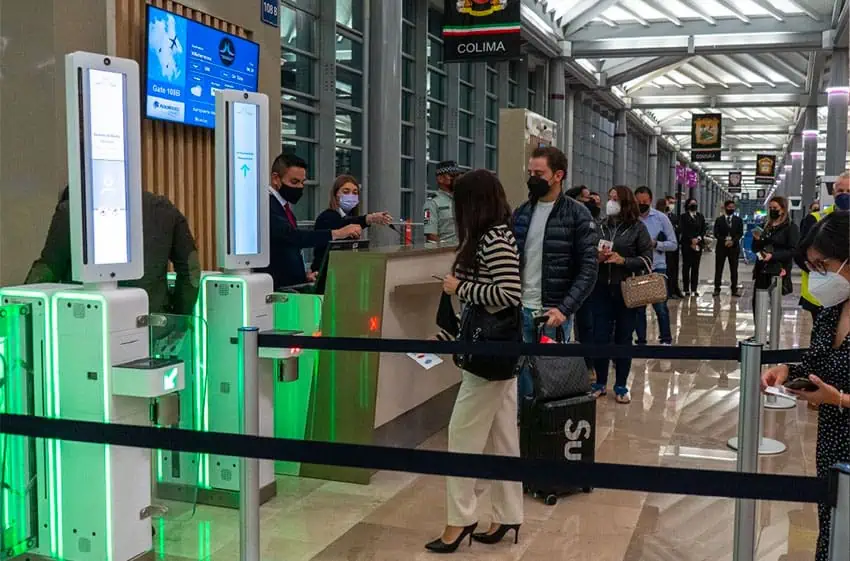
Reuters reported that check-in booths were empty and “not a single suitcase was in sight.”

The news agency also said that only a few businesses were open, including a Starbucks cafe, a Krispy Kreme stall and a gift shop. Most storefronts displayed “coming soon” signs.
While there didn’t appear to be any travelers present, the airport was not bereft of people. Airport tourists strolled around, waiting to see the delayed flight from Mérida touch down.
Despite the low number of passengers, the airport estimates that 2.4 million passengers will pass through the facility this year before that number is doubled in 2023. Passenger numbers would have to increase significantly for those targets to be met.
To reach 2.4 million passengers in 2022, an average of 8,392 people – more than quadruple the current average – would have to use the airport during the 286 days between the opening date of March 21 and December 31.
“Once we get to mid-year, I really hope there’ll be more flights,” an airport employee told Reuters, although there doesn’t appear to be any certainty that will occur.
Attracting foreign carriers to the airport apparently remains a major challenge, even though the AIFA has lower usage rates compared to the AICM and the government has offered incentives to airlines, according to an airport employee. As it stands, the AIFA only has one operational commercial runway, although a second one is planned.
Victor Manuel Peña Chávez, aeronautical engineering professor at the National Polytechnic Institute, noted that not even the AICM has the capacity to have two planes landing or taking off simultaneously.
One barrier to attracting more airlines and passengers to the new airport is its location. Concerns have been raised about the travel time needed to get there from central Mexico City, and a new highway connection and rail link to the airport have not yet been completed.
That said, getting to the AIFA will be easier than getting to the AICM for many residents of densely-populated México state.
President López Obrador – who decided to build the AIFA after canceling the previous government’s larger airport project in Texcoco, México state – unsurprisingly retains faith in the new airport, the first of his major infrastructure projects to begin operations.
He has hailed it as “one of the best airports in the world” and declared on the day of its inauguration that it was 100% complete.
But Reuters reported that the AIFA is still under construction. “Chain-link fences covered with green tarps lined the entrance to the airport, and dust painted the sky a reddish hue as construction crews continued excavation,” the news agency said.
With reports from Reuters