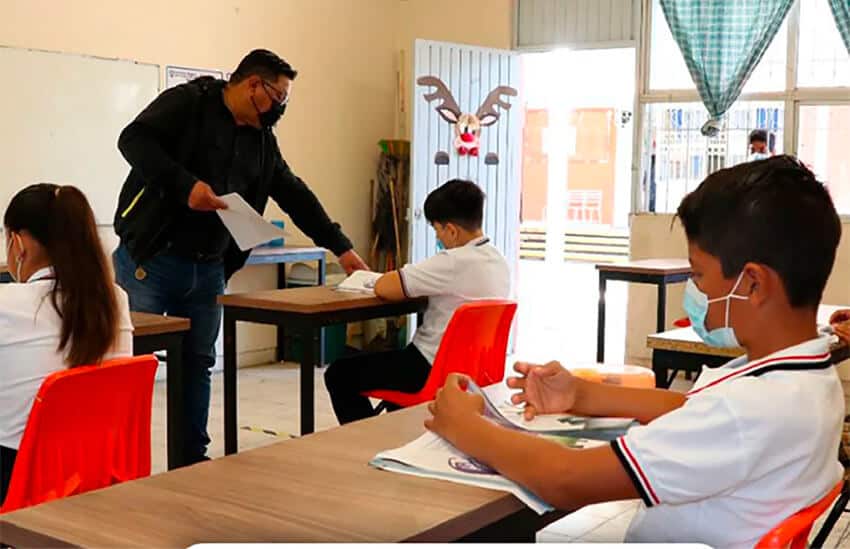
The federal government’s new curriculum model will be implemented in 960 public schools in a pilot program that will commence on October 29.
Education officials said Tuesday that the new model has provisions for teacher training and gives teachers the opportunity to co-design education programs. They also said that it allows for the development of national education strategies and will entail an “administrative transformation” of the education sector.
The new model was developed over a period of 18 months in consultation with a range of stakeholders including teachers, students, parents, indigenous people and civil society organizations. It will eventually be implemented in all preschools, primary schools and secondary schools across Mexico. The pilot program will run in 30 schools in each of the 32 federal entities.
Presenting the new education model alongside other officials, Education Minister Delfina Gómez said it was carefully designed to ensure that it brings real and lasting change to the nation’s schools. The model promotes democracy, respect for legality, self-determination and the exercising of one’s political and social rights, said Gómez, who will soon step down as education minister to contest the 2023 México state gubernatorial election as the candidate for the ruling Morena party.
According to the Ministry of Public Education (SEP), education reforms enacted by previous governments over the past 30 years fostered inequality, racism and classism. In a document outlining the new education plan, the ministry said the existing model has caused many students to leave school early and hasn’t been conducive to high academic achievement.
SEP described it as “patriarchal, colonial, scientific, Eurocentric, homophobic and racist.”
It has imposed a “hegemonic model of citizenship,” which is contrary to “a healthy life and the democratic sense,” it said.

According to SEP, Mexican schools must reclaim their roles as institutions that educate citizens to “live and co-exist in a democratic society.”
Under the new curriculum model, teachers will have “professional autonomy … to decide … their didactic exercise,” the ministry said. Schools will become “spaces where students learn values, knowledge and skills in a critical, active and supportive way.”
In summary, reported the Reforma newspaper, the new education model is characterized by its promotion of a community rather than global outlook, its elimination of concepts considered to be neoliberal (a dirty word, according to President López Obrador) and its support for teachers’ educational autonomy.
Marx Arriaga, SEP’s director of educational materials, has already overseen a process to develop new textbooks that confine neoliberalism to the dustbin of history. Teachers have played a key role in that process.
Arriaga said earlier this year that the new curriculum model will place much greater emphasis on sharing and the common good than pitting individual students against each other. The model will be “libertarian” and “humanist” and put an end to racism in the education system and “standardized tests that segregate society,” he said in late April.
With reports from El Universal and Reforma