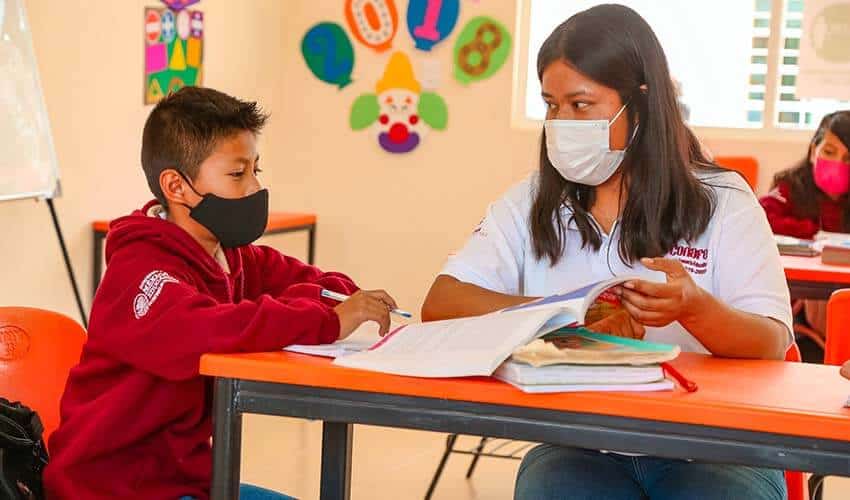
The federal government’s new curriculum model will teach students to share rather than be competitive, according to the Ministry of Public Education (SEP).
Marx Arriaga, SEP’s director of educational materials, said Tuesday that existing textbooks will be scrapped under the new model because they promote neoliberal concepts and that students won’t be required to sit international standardized tests such as the Organisation for Economic Co-operation and Development’s PISA tests – and educational objectives will be aligned with the ideals of the Fourth Transformation, or 4T, a byword both for the ruling government and the vast change it says it is bringing to Mexico.
PISA tests are benchmarking exams to assess school performance in which students respond to approximately two hours of test questions in reading, mathematics and science and answer a 30-minute student questionnaire. The school’s principal and other directors also provide information on their educational institution by filling out a questionnaire.
Mexico’s new educational model’s curriculum will place much greater emphasis on sharing and the common good than pitting individual students against each other, Arriaga said.
The model, which is still being developed, will be “libertarian” and “humanist” and put an end to racism in the education system and “standardized tests that segregate society,” he said.
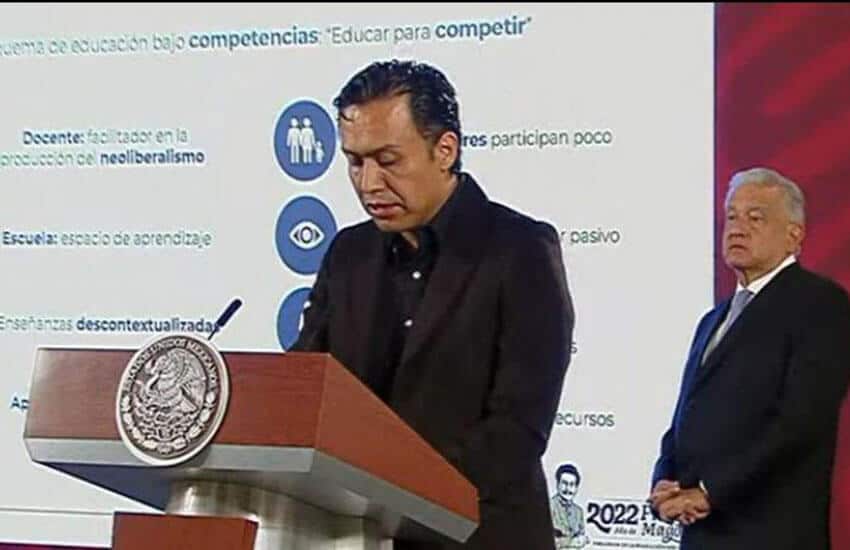
Speaking at President López Obrador’s morning news conference, the SEP official used a long list of adjectives to describe the existing “neoliberal” education model, including “punitive, racist, Eurocentric, colonial, inhumane, classist, elitist and patriarchal.”
He charged that education has become a business in Mexico “that absorbs billions of pesos a year” and is used to legitimize societal problems such as classism.

While the new education model hasn’t yet been introduced, Arriaga said that the Education Ministry — which he charged had become a “bureaucratized and dehumanized institution” — has been “re-engineered” over the past three years. The educational materials chief has dedicated much of his time to overseeing the process to develop new textbooks that confine neoliberalism — one of López Obrador’s professed pet hates — to the dustbin of history. Teachers have played a key role in the process.
The president said Wednesday that the new textbooks will help students become good citizens. “We have to review the educational contents. We’re not going to be forming … dehumanized, selfish people,” López Obrador said, adding that “that was the plan of the neoliberal model.”
“… We’re going to be informing constantly about the education plan,” he told reporters at his regular news conference.
“Taking care of teachers is very important because education is in essence a teacher who wants to teach and a student who wants to learn. Where? Wherever. Of course, it’s better if the educational facilities are good, but the basic things are the educators and those being educated,” López Obrador said.
Arriaga said Tuesday that teachers would be considered “community leaders” under the new education model and would no longer be stigmatized.
Some education experts were critical of the education vision he outlined on Tuesday. Alma Maldonado, an education researcher at the National Polytechnic Institute, said there is more ideology than pedagogy in the government’s education plan.
“It’s a completely ideological proposal … that borders on the absurd,” she said. “It would seem that everything from before is terrible and neoliberal.”
Marco Fernández, an academic at the Tec de Monterrey university, said that the government’s plan is confusing and ambiguous. He also said that the SEP should clarify whether the new education model will be trialed in a pilot program.
Both Maldonado and Fernández said that the model didn’t appear to take into account pandemic-related problems, such as the high number of students who dropped out of school or fell behind in their learning when they couldn’t attend in-person classes.
“The most ironic thing is that this discussion is not focused on the educational emergency,” Fernández said.
“[Education officials] intend to behave as if nothing had happened, as if enrollment in the different education systems had not declined,” he added.
With reports from Reforma