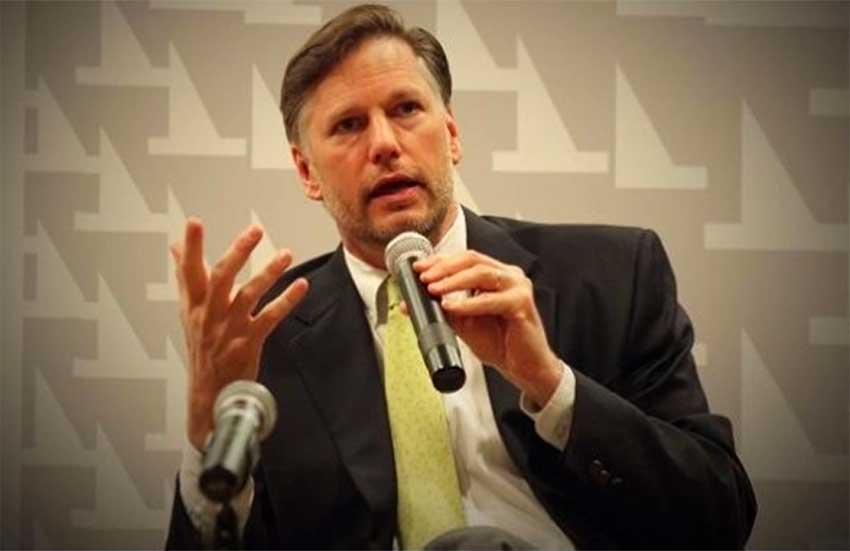
United States President Donald Trump’s nomination of Christopher Landau to be his new ambassador to Mexico sends a message that he intends to maintain a “firm hand” in bilateral relations, according to an international relations expert.
The White House press office said in a statement Monday that Trump intended to nominate Landau, a constitutional and appellate attorney, to the post that has been vacant since Roberta Jacobson resigned last May.
Javier Urbano, a professor at the Iberoamerican University in Mexico City, told the newspaper El Financiero that Landau will be an embodiment of Trump’s “firm hand” approach to Mexico, and that he will have limited scope to establish more cordial relations with Mexico.
“They’re sending us a makeshift [ambassador], he’s a lawyer who will have little room to maneuver,” he said, adding that the outlook is poor for Mexico-United States relations in coming years “unless the relationship goes through channels other than the embassy.”
Urbano contended that Landau doesn’t have the necessary skills and experience required to effectively manage the complex relationship between the two countries, and that his proposed appointment “doesn’t send a message from the United States government that [it wants to] increase the level of cooperation” between the two.
Bilateral relations have warmed slightly President López Obrador took office in December but under the Enrique Peña Nieto government, they became openly hostile as migration, trade and Trump’s border wall proposal were front and center in the antagonism.
Jacobson’s resignation as ambassador was widely seen as a response to the incompatibility of her views about how the bilateral relation should be conducted with those held by Trump.

Indeed, Jacobson slammed the U.S. president’s immigration policies after she left, calling them “un-American” and counterproductive.
For almost a year, the ambassador’s post has remained vacant, and the failure to appoint a replacement was interpreted by some as a slight by the U.S. towards its southern neighbor.
Kimberly Ann Nolan, a professor at Mexico City’s Latin American Social Sciences Institute (Flacso), asserted that proposing Landau – who has no prior diplomatic experience – shows that the United States is not placing the value on the relationship with Mexico that it deserves.
“By sending a person who is not qualified [to be an ambassador], the United States is sending a message that they don’t care,” she said.
In contrast, Raúl Benítez, a researcher at the Center for Research on North American (Cisan) at the National Autonomous University (UNAM), took a more positive view.
He said Landau’s background as a lawyer is evidence that the United States intends to place greater emphasis on the legal aspects of the relationship, including those within issues such as drug trafficking, migration and trade.
“[The appointment] could be positive if the relationship between both governments is positive and if it helps to resolve a lot of legal cases . . . [related to] drug trafficking and extraditions . . .” Benítez said.
The fact that Landau doesn’t have prior experience as a diplomat “is not a sin,” he added, pointing out that a lot of Mexican ambassadors don’t have diplomatic backgrounds either.
Benítez also said that Mexico could benefit from the presence of a United States ambassador who is much closer to the U.S. president than his predecessor.
Beyond his legal experience, the White House said the 55-year-old Landau has a certificate in Latin American studies from Harvard University and is fluent in Spanish, a skill that could be useful in any direct dealings with President López Obrador.
Source: El Financiero (sp)