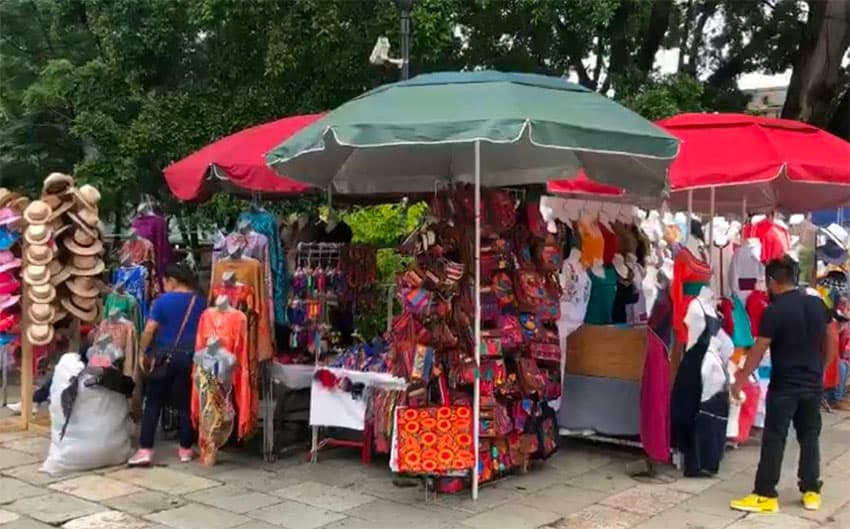
Two hundred street vendors set up their stalls in the historic center of Oaxaca city on Saturday in defiance of efforts to clear the area of unregistered stalls. The move came just two days after the local government sent out a 500-strong security force to remove 1,500 stalls that lacked licenses.
Municipal authorities ordered the removal of all unlicensed stalls on Thursday, bowing to pressure from local business owners, and erected metal barriers to prevent sellers from reentering. It had been estimated that there were more than 3,000 unregistered stalls in the historic center.
The following day, the vendors tried to enter two of the city’s central squares, which had been cordoned off by police. On Tuesday, disabled vendors, some of whom walked on crutches, marched on the central square arguing they had no other form of income and that they do not set up fixed stalls.
Some sellers insist that the council is refusing to recognize their permits, which cost as much as 24,000 pesos (about US $1,200), and that seasonal permits for 5,500 pesos had also been rejected.
A group of vendors, led by Carmen Luján from the Independent Merchant’s Union, marched on government offices in protest on Saturday and said they would remain in the main square. Luján has requested dialogue with Mayor Oswaldo García Jarquín and Governor Alejandro Murat, due to what the group has described as the “incompetence” of municipal authorities.
Mayor García said that unlicensed vendors would no longer be tolerated and that no new permits would be made available until a review of every permit had been completed.
He has also denied that the stalls had been removed to placate a production company set to film in the city center.

Meanwhile, Governor Murat has proposed a plan to introduce mobile stalls to prevent fixed stalls being set up.
However, he made clear that formal business owners would be prioritized. “We have to strike a balance. We have to find how to create social benefit for people, while also putting formal traders first, the ones that pay, and then the the informal traders,” he said.
The governor added that it was important to regularize informal sellers to give them legal protection from groups charging them fees. “[It will] end the corruption of groups and leaders who charge floor fees for selling in public spaces, without having any legal power to do so,” he said.
With reports from Milenio, Imparcial Oaxaca and El Universal