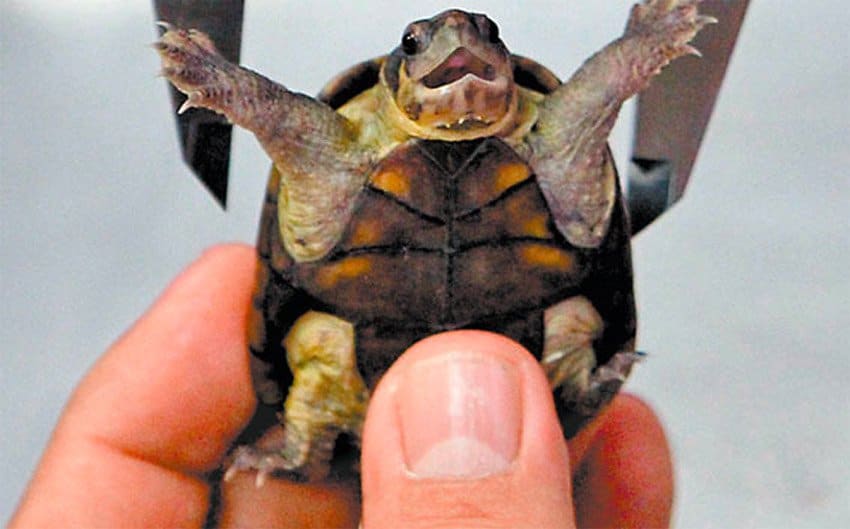
A small mud turtle first discovered by residents of Puerto Vallarta 20 years ago was recognized as a new species last month, but now it is also considered one of the most threatened freshwater turtle species in the world.
The distinct looking turtle became known in the Jalisco city as casquito de Vallarta, or little Vallarta helmet, due to the shape of its shell.
Residents alerted experts some 20 years ago about the find, but they decided they were nothing more than juvenile specimens of another species.
But five years ago they gave another look at the diminutive turtle, the results of which were published on May 16 in a study entitled A Distinctive New Species of Mud Turtle from Western México in the journal Chelonian Conservation and Biology.
Studies performed on nine turtle specimens, five of them dead, led by a team of scientists from research institutions in the states of Tabasco, Jalisco, Mexico City, Guanajuato and Veracruz found that the turtle indeed belonged to a new species, Kinosternon vogti.
The Vallarta mud turtle, the largest specimens of which are 10 centimeters long, has only been found in a few human-created or human-affected habitats such as small streams and ponds found only around the resort town of Puerto Vallarta. All of the mud turtle’s currently known habitats have been damaged by urban growth.
Of the four known living specimens only one is a female. It was sent along with a male to a reproduction center in Tabasco, while the two other males remain in Puerto Vallarta.

The five turtles found dead have been deposited in a collection at the National Autonomous University of México, where they will be subject to further studies.
The Chelonian Conservation and Biology paper said “an urgent conservation program is necessary as well as explorations in the area to find viable populations of the species.”
The name of the new turtle species pays homage to Richard Vogt, a herpetologist and turtle conservationist who has studied the reptile for 40 years.
Source: Milenio (sp)