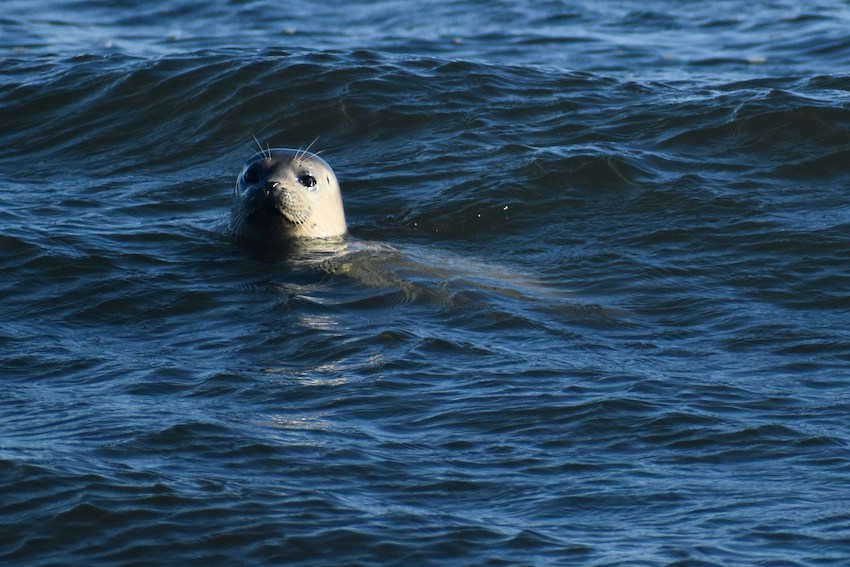
Pacific harbor seals — the playful, whiskered charmers found along the West Coast from southern Alaska to Baja California — are vanishing at an alarming rate from their southernmost range, new research shows.
A study found a 61.2% population decline on the Baja California Peninsula over a six-year period, with researchers recording a drop from 7,380 individuals in 2016 to 2,863 by 2022.
The study was led by the Center for Scientific Research and Higher Education of Ensenada (CICESE), a public research institute in Baja California founded by the federal government in 1973.
The Autonomous University of Baja California (UABC) and the University of the Americas Puebla (UDLAP) also contributed.
“This is a decline by colony as well as across the entire area,” said María Guadalupe Ruiz Mar, a doctoral student at CICESE. She noted that colonies have collapsed from 44 in 2009 to just four sites this year, as revealed by aerial surveys conducted from April to June.
The species, though not listed as endangered, currently has special protection under Mexican official standard NOM-059, which is currently under review.
“It would be a good time to reconsider their conservation status,” said Gisela Heckel Dziendzielewski, a CICESE researcher and director of the study. “Their disappearance is a clear sign that the marine and terrestrial ecosystem is under pressure. Protecting their habitat also means protecting the health of the ocean.”

“If food availability is low, seals don’t have the energy reserves necessary to increase the number of pups,” Ruiz Mar added. “If the female isn’t well-fed and doesn’t have enough fat reserves, she won’t carry a pregnancy to term or be able to breastfeed successfully.”
Affectionately known as “sea puppies” for their dog-like eyes and playfulness, the Pacific harbor seal (Phoca vitulina richardii) inhabits nine islands and archipelagos off the Baja Peninsula and parts of the coast.

They are not to be confused with the much larger elephant seal, and specifically one named Panchito — a rugged individualist who once again in 2025 traveled thousands of kilometers from his chilly home waters in the Southern Hemisphere to “summer” in Baja California.
Pacific harbor seals prefer nearshore coastal environments, especially subtidal and intertidal zones, bays, and estuaries. They frequently hang out on rocky shores, mudflats, sandbars and occasionally glacial ice for rest, molting and pupping.
“Seals are very sensitive to disturbance,” Ruiz Mar said. “We believe the presence of people and vehicles during [rock quarrying] causes them to persistently flee into the water and abandon the sites where they rest and breed.”
With reports from La Jornada and El Imparcial