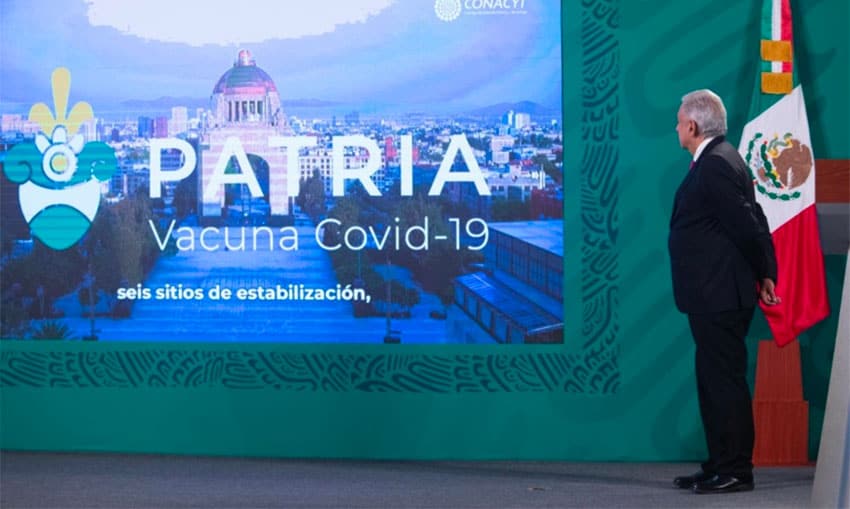
Media reports, including one by Mexico News Daily, were critical of the federal government for describing a new Covid-19 vaccine as a homegrown invention when it was actually developed in the United States.
But the national pride of President López Obrador and National Council of Science and Technology (Conacyt) director María Elena Álvarez-Buylla that was on display at a press conference last week was not unwarranted.
The vaccine candidate, to be called Patria, is indeed being developed in Mexico with technology from the Icahn School of Medicine in New York as well as a HexaPro protein developed by the University of Texas at Austin.
While the United States-developed technology and protein are crucial to the vaccine’s development, the role of a Mexican company making the vaccine is also critical.
The veterinary pharmaceutical firm Avimex – in alliance with Conacyt, a federally-funded agency, the Mexican Social Security Institute and the National Autonomous University – has been working on the development of the vaccine since March 2020.
Avimex said in a statement that it used existing technology from its veterinary influenza vaccine – which has been shown to be safe for humans – to develop an effective vaccine against Covid-19, which has claimed more than 300,000 lives in Mexico.
“After analyzing the technological platforms at its disposal, Avimex determined that a recombinant Newcastle disease virus (rNDV) has the potential for success for the Covid-19 vaccine,” the company said.

“The development of the Mexican Patria vaccine against SARS-CoV-2 is the result of a combination of different efforts and national and international, public and private, collaborations,” Avimex said.
“… This example of strategic and solidary cooperation is proof that our country has the necessary elements such as talent, ability and infrastructure to confront urgent challenges in health.”
Álvarez-Buylla said last Tuesday that the Patria vaccine could be granted emergency use authorization in late 2021. She also said that clinical trials with volunteers could begin later this month or in May.
The news agency Reuters reported that other versions of the vaccine, developed by researchers in those countries in conjunction with the U.S. institutes, will undergo clinical trials in Brazil, Thailand and Vietnam.
However, Avimex’s version is the only one to be tested that contains an active virus, according to a company spokeswoman. She said Avimex has developed its vaccine in the form of an intranasal spray as well as the more traditional injection.
The company said it intends to produce the vaccine on an industrial scale if it successfully passes clinical testing.
Its possible use is still more than six months away and Mexico hopes to have a majority of the population vaccinated before the end of the year but access to a cheap, Mexican-made vaccine would nevertheless be a boon. The government to date has relied on foreign-made vaccines, shipments of which have not always arrived when they were expected.
As of Sunday, more than 14.2 million vaccine doses had been administered in Mexico, mainly to seniors and frontline health workers. Only 8.9% of the population is vaccinated, according to The New York Times vaccinations tracker, and 3% is fully vaccinated, meaning that they have received both shots of two-dose vaccines or were inoculated with the CanSino vaccine, the only single-shot vaccine Mexico is using.
Mexico News Daily