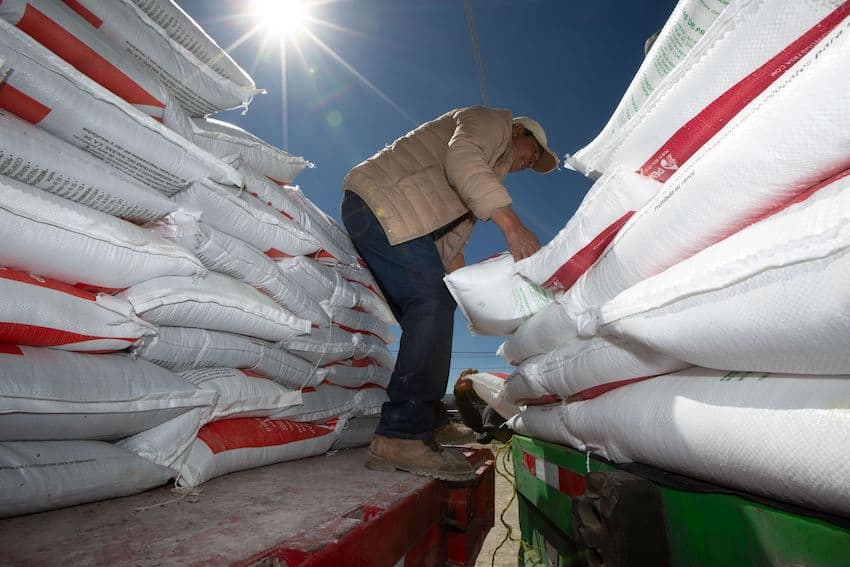
The large investment in Mexico’s petrochemical and fertilizer industries announced by Pemex CEO Juan Carlos Carpio earlier this month won’t improve the state oil company’s financial situation, according to an energy expert who spoke with the news outlet El CEO.
At President Claudia Sheinbaum’s June 5 press conference, Carpio announced a 93-billion-peso (US $5.4 billion) public-private investment plan aimed at revitalizing Mexico’s petrochemical and fertilizer industries. Sixty-two per cent of the resources are slated to come from the government, with the remaining 38% to be invested by the private sector. With the investment plan, the government is seeking to strengthen food security and reduce Mexico’s dependence on imported fertilizers and petrochemicals.
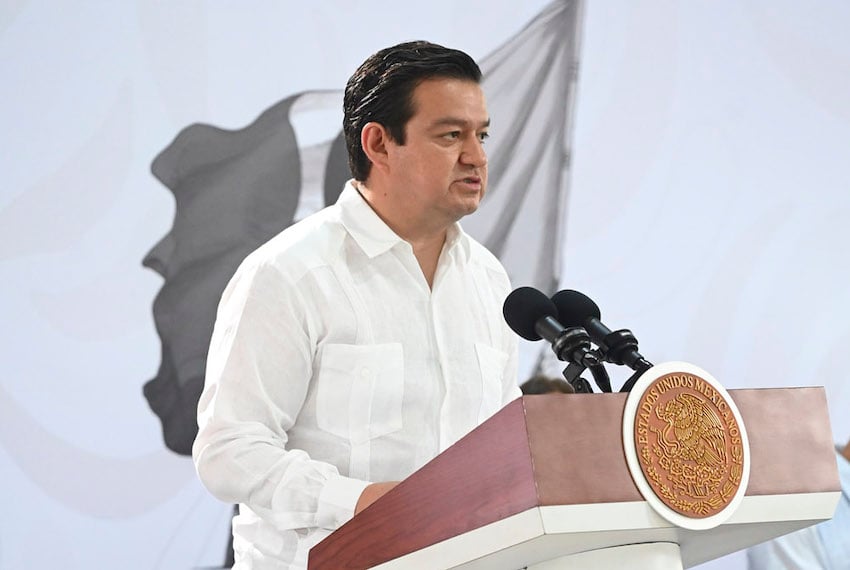
Carpio said that the 93 billion pesos would be invested in various projects between 2026 and 2030. Mexico Business News reported that the centerpiece of the investment plan is a 25-billion-peso ammonia and urea plant in Poza Rica, Veracruz, that is expected to produce 708,000 tonnes of granulated urea annually.
“The Poza Rica facility, developed at the Escolín Petrochemical Complex, is being executed through a partnership between Pemex Industrial Transformation and Portuguese construction firm Mota-Engil, and has been under development since 2025,” Mexico Business News reported.
Significant amounts of money will also go to upgrading existing petrochemical facilities and building new ones, Carpio said on June 5.
He told Sheinbaum’s press conference that “the reactivation” of Mexico’s fertilizer and petrochemical sectors will provide Mexico with “the opportunity to once again produce in our country, strengthening national industry and food security, reducing supply chain vulnerabilities and contributing to the creation of jobs.”
Energy expert: The investment is ‘irrelevant’ for Pemex
While former President Andrés Manuel López Obrador claimed to have “rescued” Pemex from years of neglect under previous governments, the fact remains that Mexico’s state oil company is heavily indebted and losing money. Pemex said that its debt fell to an 11-year low at the end of 2025, yet it was still an estimated US $84.5 billion in arrears.

Energy expert Paul Sánchez told El CEO that the investment in petrochemical and fertilizer projects affiliated with Pemex won’t help to remedy the state oil company’s problematic financial situation.
“For Pemex it’s irrelevant,” he said.
Sánchez said that petrochemicals and fertilizers are not “a central business” for Pemex, nor will those industries “generate a return on investment that changes its financial situation.”
He did, however, acknowledge that the fertilizer and petrochemicals are “strategic” for Mexico.
As things stand, “Mexico’s agricultural sector is structurally dependent on imported fertilizers, primarily urea sourced from the United States, Russia and China,” Mexico Business News reported.
“That dependence creates direct exposure to geopolitical supply disruptions, exchange rate volatility, and the same kind of strategic vulnerability that … [Energy] Minister [Luz Elena] González has been invoking in the context of natural gas imports,” the news outlet wrote.
While it remains to be seen whether the 93-billion-peso investment can reduce reliance on fertilizer and petrochemical imports — a key goal of the government’s Plan Mexico economic initiative — Mexico Business News wrote that the “ambition” of the investment initiative “is matched by an equally documented history of underperformance on large-scale petrochemical and fertilizer projects.”
“Analysts note that Pemex’s heavy debt load and history of delays and cost overruns on large projects raise questions about whether the company can successfully deliver the ambitious program on schedule and within budget,” the news outlet reported.
For his part, Víctor Ramírez, founding partner of energy consultancy Perceptia 21, told El CEO that Pemex Industrial Transformation, a subsidiary of the state oil company that operates petrochemical complexes, is one of the main sources of financial losses for Pemex.
“Pemex Industrial Transformation has been one of the areas that has most damaged the financial results of the company,” said Ramírez, who contended that there are questions about what the real cost of the fertilizer and petrochemicals investment will be.
He also said that “if we’re going to substitute imports by producing fertilizers at very high costs or which require permanent subsidies,” investing in the domestic industry “is not necessarily a desirable strategy.”
Sheinbaum targets natural gas production as next step in energy sovereignty push
Sánchez said that one of the greatest challenges of increasing the production of fertilizers and petrochemicals in Mexico will be guaranteeing the supply of the required raw materials. Natural gas — a fuel for which Mexico is heavily dependent on imports from the United States — is the primary feedstock for urea and ammonia.
Carpio to visit Brazil this month, says Petrobras chief
As Sánchez noted, fertilizers and petrochemicals are not the main game for Pemex. Rather, the company’s central focus is oil: extracting crude from onshore and offshore fields and refining it at one of the eight refineries it operates — seven in Mexico and one in the United States.
To aid oil exploration in deepwater fields, Sheinbaum said earlier this month that Pemex would sign an agreement with its Brazilian counterpart Petrobras as soon as this month.
“Why is this agreement important? Because Petrobras is an expert in exploration and production in deep water. And it’s also an expert in a technique that only they have,” she said June 2, explaining that said technique makes it possible to determine whether there are additional oil reserves “at greater depths” in fields that have already been exploited.
While the Pemex-Petrobras agreement has not yet been signed, the chief of the Brazilian company, Magda Chambriard, said Friday that Carpio was expected to visit Brazil this month.
According to a Bloomberg report, Chambriard said that Petrobras and Pemex “are seeking to sign initial documents including non-disclosure agreements and memorandums of understanding to begin joint studies for offshore exploration in Mexico’s side of the Gulf [of Mexico], oil production and refining.”

Bloomberg reported that Pemex didn’t respond to a request for comment.
Brazilian President Luiz Inácio Lula da Silva first floated the idea of a joint venture between Petrobras and Pemex in March, saying that the latter could “get a great deal of help” from the former.
Lula, as the president is best known, spoke to Sheinbaum last Wednesday. On Thursday, Sheinbaum reiterated that Pemex was close to signing an agreement with Petrobras.
“As I’ve said, they have highly-developed techniques for deepwater and ultra-deepwater exploration,” she said.
Sheinbaum said that Pemex and Petrobras could together work toward the joint exploitation of an oil field in the Gulf of Mexico, which is Mexico’s main source of crude.
With reports from El CEO, Bloomberg and Mexico Business News