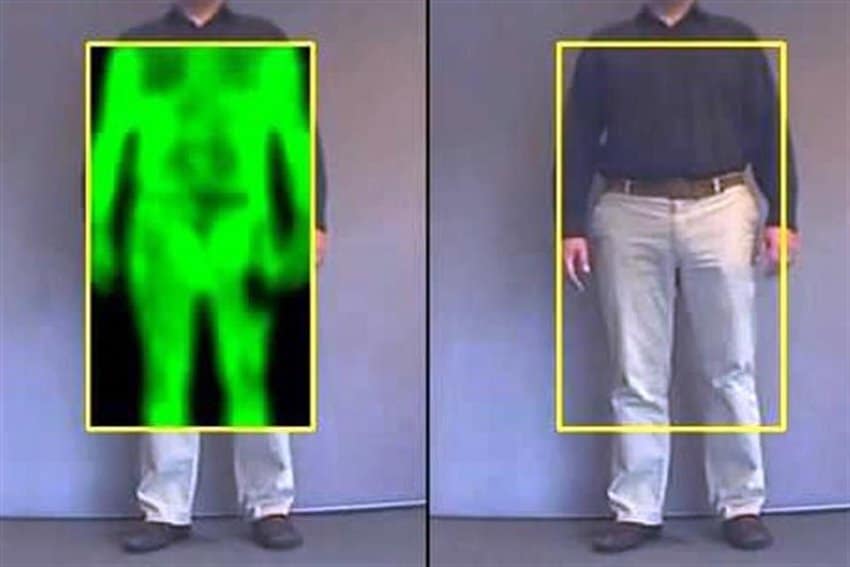
Pedestrians crossing the Mexico-United States border between Ciudad Juárez, Chihuahua, and El Paso, Texas, will soon be subjected to high-tech body searches.
Mexican authorities will collaborate with the United States government on a pilot program to install body scanners at three crossings between the two border cities.
In a document posted to a government procurement portal, the U.S. Department of State informed interested suppliers on October 10 that it plans to purchase 14 “compact detection units” that have the capacity to detect contraband hidden under clothing and even inside a person’s body.
Currently, only X-rays taken at a hospital can detect if a person has ingested contraband or otherwise placed it inside the body for the purpose of smuggling it across the border.
The newspaper Reforma reported today that one of the scanners sought by the Department of State is the Thru Vision TS4-C.
Thru Vision’s website says that the TS4-C is a “proven people-screening camera that sees any type of item — including metal, plastic, ceramic, gel, liquid, powder and paper — hidden under people’s clothing at distances of three to four meters.”
It also has the capacity to conduct “360° person screening at a rate of one person every 12 seconds” and relay information in real time, the company said.

According to the Department of State document, “the system must have the capacity for an effective flow of information of up to 100 people per hour in order to manage a high-traffic environment.”
To detect contraband inside the body, the State Department is seeking to purchase the RadPRO SecurPASS Full Body Security Screening System, made by Canon, or an equivalent system.
Canon’s website says that the system is “designed to handle certain high-level security needs of prisons, border crossings, jails, and government facilities,” adding “this low-dose X-ray screening system detects many types of illegal substances and weapons, both internally and on the body.”
With the acquisition of such a system, people suspected of carrying contraband such as drugs internally will not have to be taken to a hospital or clinic to be examined by X-ray, a process that is time-consuming and costly.
The RadPRO SecurPASS costs around US $200,000 per unit.
“The government will evaluate the utility and reliability of this new technology in an operational environment to determine if it provides the solution required,” the State Department said.
Source: Reforma (sp)