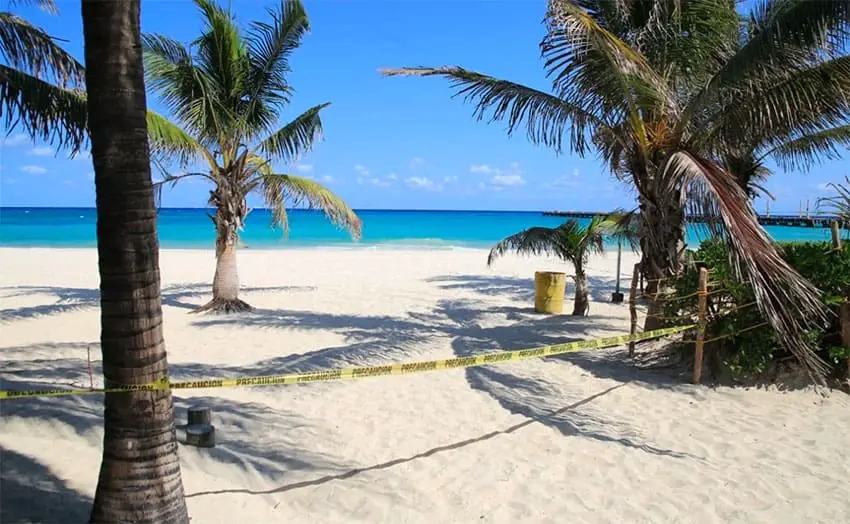
Despite the fact that the state of Quintana Roo is still listed at level orange on the stoplight risk map, Playa del Carmen has announced it will reopen its beaches between August 20 and 30, using social distancing mechanisms to protect citizens.
Mayor Laura Berinstain said she made the decision based on her belief that the state’s risk level rating will change to yellow from red within the following week, which she says is based on statements by Governor Carlos Joaquín González that the municipalities of Cancun, Puerto Morelos, Solidaridad (in which Playa del Carmen is located), Cozumel, Isla Mujeres, Tulum and Lázaro Cárdenas are close to bringing down their risk level and easing restrictions.
Berinstain’s government said the reopening will be considered a pilot program, using protocols based on experiences shared by the municipality of Los Cabos, and advice from Civil Protection and other government agencies. Solidaridad’s reopening will be accompanied by social distancing guidelines and prohibitions against drinking alcoholic beverages and littering.
Solidaridad health director Héctor Gonzáles Rodríguez said that even though the number of cases in the municipality has remained stable, the coronavirus continues circulating, and thus there still exists a risk of contagion. No matter what the risk rating is, citizens should continue to follow protective measures such as wearing face masks, washing hands and avoiding large gatherings.
The state, which changed to the orange risk level on Monday, has seen a total of 8,761 coronavirus cases, with 1,128 deaths. The total accumulated number of cases in Solidaridad is currently 1,137, with 108 deaths. This is lower than in nearby Cancún, which has seen 4,189 confirmed cases and 797 deaths.
Source: El Universal (sp)