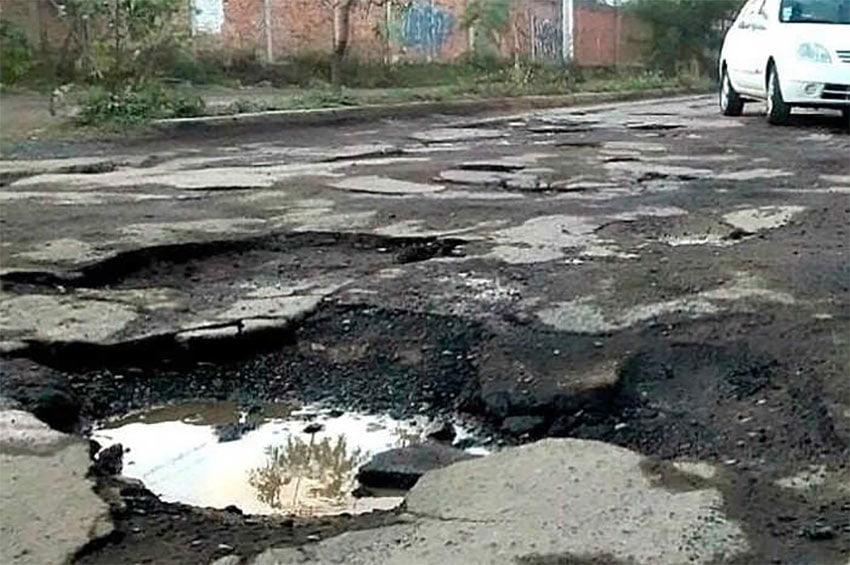
The president announced a nationwide plan to repair potholes during Monday’s press conference in response to a question about the security situation in Mexico.
A journalist challenged the president on security and presented data published by the federal statistics agency Inegi indicating that 66.6% of adults feel that living in their cities is unsafe.
But the president pointed to other Inegi data: 75.9% of respondents believe the main problem in their cities is potholes, while 58.5% listed street lighting as an issue.
Crimes such as robberies, extortion and kidnappings appeared as the fourth highest concern, at 56.7% in March and 56.2% in June.
“Soon we’re going to run a special program for potholes [in cities] all over the country. We are going get agreement with state governments, with municipal governments, because it is the main problem for the people who live in the cities,” the president said.
“Look what is in first place: potholes in the streets … We’re going to allocate a special budget,” he added.
As for security, the president attributed high rates of homicide to the mistakes of his predecessors.

Earlier in the conference, which took place in Puerto Vallarta, Jalisco, Governor Enrique Alfaro Ramírez revealed that homicides had increased 20.6% in the state in the first six months of 2021 compared to the same period in 2018.
Of the 1,492 murders reported in the first half of the year, 194 of the victims were found in clandestine graves and 1,296 were victims of direct attacks. Alfaro added that 81% of the murders were related to organized crime.
Jalisco is the base of the Jalisco New Generation Cartel, which is arguably the most powerful organized crime group in the country.
With reports from Reforma