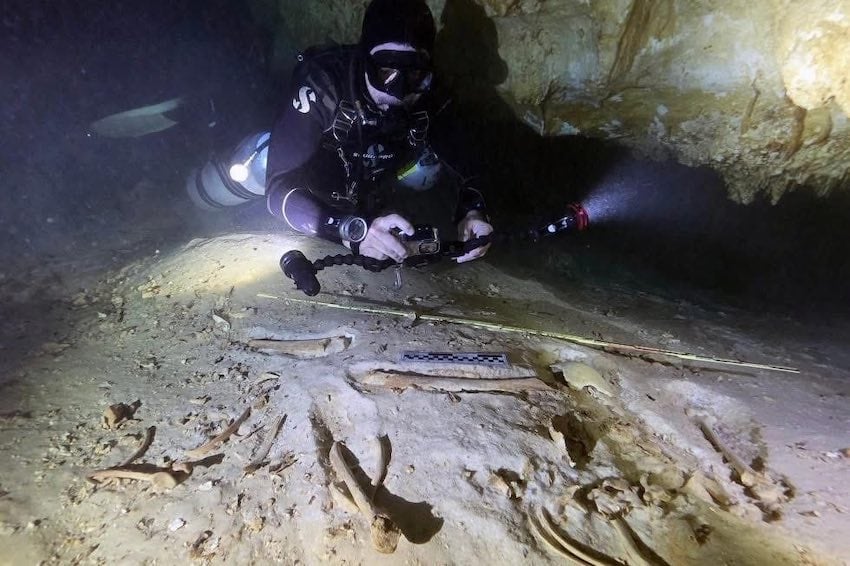
A prehistoric skeleton has been found in the underground river and cave system along Mexico’s Caribbean coast.
Octavio del Río, the cave-diving archaeologist who was among those who made the find, said it is the 11th such skeleton found in the region over the past three decades. Some of the earlier discoveries date back as far as 13,000 years, older than what was originally thought to be the earliest arrival of humans to the Americas (as detailed with a similar but earlier nearby finding that accompanies this article).
8,000 year-old human skeleton discovered by cave divers near Tulum
The discovery was made between Tulum and Playa del Carmen in the state of Quintana Roo, an area that archaeologists consider strategic for research into the earliest inhabitants of North America.
Del Rio, who works with the National Institute of Anthropology and History (INAH), told The Associated Press in late February that the skeleton was “found in a flooded cave about 26 feet (8 meters) below the surface after swimming about 656 feet (200 meters) through the cave.”
The intricate underground system that runs beneath the coast of the Mexican Caribbean was flooded toward the end of the last ice age, roughly 8,000 years ago.

It is most probable that the remains arrived at the site when the cave was still dry, Del Rio said.
The skeleton — which was discovered late last year — was positioned on a dune of sediment in a narrower part of an inner chamber. Del Río said it is virtually certain that the bones were placed there intentionally.
Ongoing analyses and studies will provide more details about the context, antiquity and practices of the region’s ancient inhabitants.
Previous research suggests the area of the finds functioned as a burial site where ritual practices were performed by the first peoples who inhabited the region. The position of the remains reinforces this interpretation.
Luis Alberto Martos, director of archaeological studies at INAH, said this discovery will help clarify how the first settlers arrived on the Yucatan Peninsula and how they used the caves in prehistoric times.
Recent genetic data support the hypothesis of a migration from Asia across the Bering Strait, although there are still indications of possible routes from South America.
In addition to human remains, the underground rivers and cenotes hold the remains of extinct animals, such as giant sloths, saber-toothed tigers and ancestral bears.
Archaeologists hope these discoveries will contribute to understanding how ancient populations adapted to the Yucatán Peninsula while aiding in the reconstruction of Ice Age ecosystems in future research.
Given the ecological vulnerability and archaeological significance of the region, scientists have urged officials to designate the underground area as a protected natural and cultural heritage site, in recognition of its historical and environmental importance.
With reports from The Associated Press, Infobae, Diario Cambio 22 and El Universal