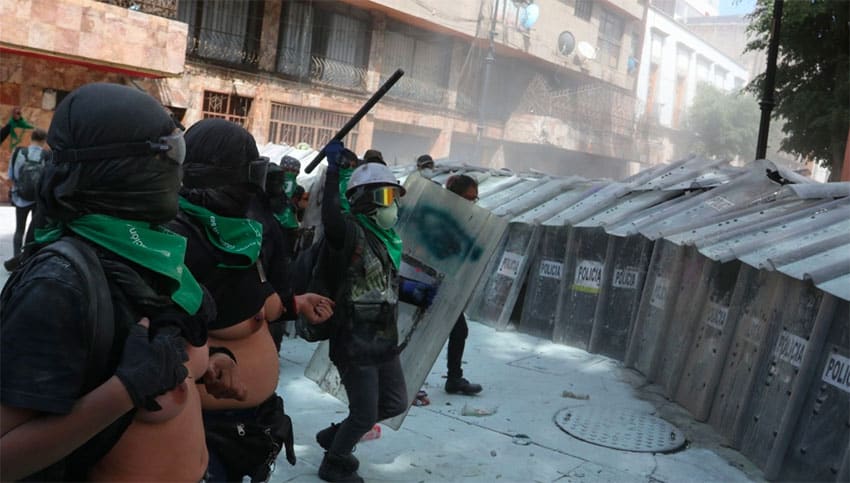
A group of about 40 women clashed with police in the historic center of Mexico City on Sunday during a pro-abortion march.
Members of the Bloque Negro feminist collective along with victims of abuse departed the headquarters of the National Human Rights Commission (CNDH) – which was taken over earlier this month by a women’s group and turned into a shelter for victims of gender violence – at 2:00 p.m. but their march was soon blocked by a contingent of more than 600 police officers led by policewomen.
The confrontation between the two parties quickly turned violent.
With their path blocked, women threw Molotov cocktails at the police on “repeated occasions,” according to the Mexico City government. They also graffitied buildings and caused damage to a convenience store.
The women, some of whom wore masks that covered their entire faces, also confronted the shield-wielding police with hammers and prohibited electrical apparatuses, according to a government statement, evidently referring to electroshock weapons.
A female reporter was pushed against a wall of the National Museum of Art, the newspaper El Universal said.
Eleven police officers sustained injuries including burns during the clash and eight were taken to hospital for treatment, the government said.

The protesters said they were victims of police violence.
“They pulled my hair, they choked me with a green handkerchief I was wearing around my neck, they grabbed me by my arms and they beat me in the face and ribs,” said Érika Martínez, a protester and mother of a girl who was a victim of sexual abuse.
While the clash between the protesters and police was occurring, women occupying the CNDH headquarters removed furniture, clothes and paper and set the objects alight on Cuba Street to prevent any attempted police incursion into the building, where women and children are taking shelter.
Women occupying the building say that police vehicles frequently approach the building before turning around, conduct they consider to be a threat.
After being corralled in the street by police and prevented from leaving for four hours, the protesters were finally allowed to return to the CNDH offices.
The Mexico City government said it had identified the protesters who attacked police and vandalized property and that they would be dealt with in accordance with the law.
It said that the aim of police was to “accompany and protect” the march but the actions of the protesters placed themselves, the media and other citizens in danger.
Women in several parts of Mexico have protested this month against the high levels of gender violence and what they say is a failure by authorities to address the problem.
There were also protests after a majority of Supreme Court justices voted in July against upholding an injunction granted in Veracruz that ordered the state Congress to remove articles from the criminal code that stipulate that abortion in the first 12 weeks of pregnancy is illegal.
Abortion activists had hoped that the court would deliver a landmark ruling that would pave the way for the decriminalization of abortion across Mexico.
Mexico City and Oaxaca are the only states that have decriminalized abortion, the latter doing so in September last year.
Source: El Universal (sp), Milenio (sp)