A love for dogs inspired a young man to pursue a project in Oaxaca city to ensure that animals living on the street have something to eat and drink.
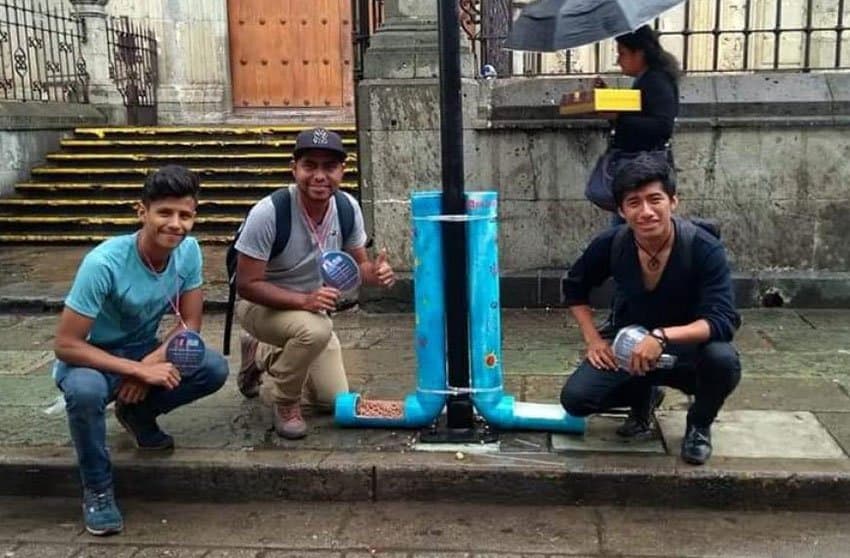
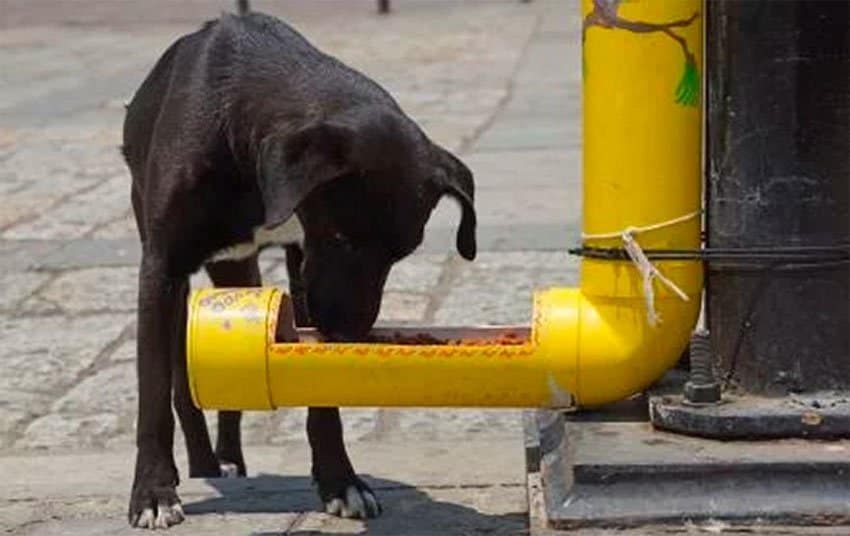
Jonathan Tonatiuh Hernández Eslava, a 24-year-old México state native, paints and installs PVC tubing which functions as feeding stations for street dogs and other domestic animals that don’t have a home.
Two other people contribute to the project which Hernández called Tetheo, a variation of a Náhuatl word that means universe.
The activist told the newspaper El Universal that the idea for his project came after seeing dogs eating garbage and drinking from puddles in the street.
“You grow up in a social paradigm in which it’s normal, that it should be that way, not just for animals but also for people who live on the street,” he said.
“We need to learn the value of life . . . We want to create awareness . . . and a culture of helping animals.”
Hernández and the two other members of his team initially asked municipal authorities for permission to go ahead with their project but even though they got a negative response, they proceeded all the same.

Their first feeder, which was made out of a large water bottle and another plastic container, was placed outside a Oaxaca church last September.
However, it didn’t last long: a parish priest threw it away and was captured on video in the act, drawing the ire of animal rights activists who saw the footage on social media.
After that, Hernández decided to take a different approach by using PVC pipes to make the feeding stations and affixing them to posts.
There are now four brightly colored feeders adorning the streets of Oaxaca city and, according to Hernández, they have been largely accepted by residents because they help to beautify the city.
Each hand-painted pipe features the Náhuatl word for food or water depending on what its feeder section contains as well as a poem in the indigenous language.
Hernández said that promoting indigenous identity and culture is another important aspect of his project.
To ensure there is enough money to buy food and keep the feeders filled, the Tetheo collective carries out fundraising initiatives such as raffles. Locals have also donated money and dog food to the cause.
In the future, Hernández hopes that his project will grow with the assistance of other people who want to improve the lives of street dogs.
“The collective’s intention is for the project to expand to all of Oaxaca . . . The idea is that little by little people will get to know the project and join the initiative by helping us to fill the containers or installing one in their neighborhood.”
Source: El Universal (sp)