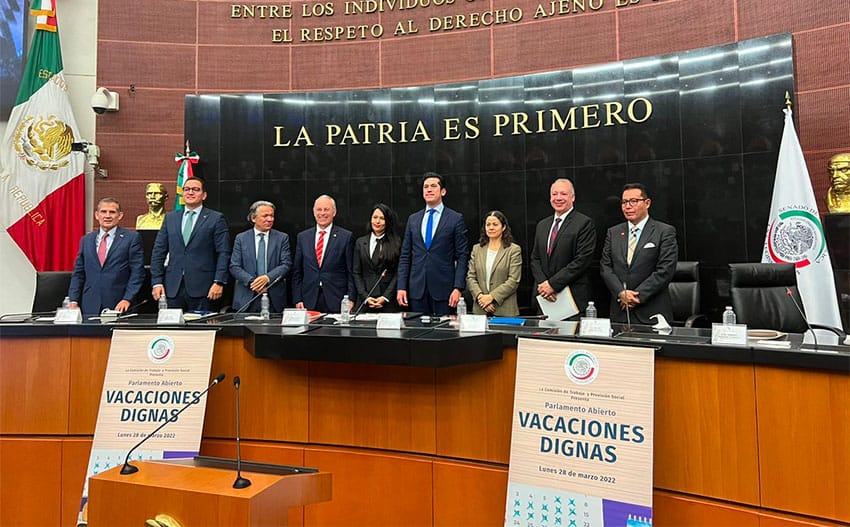
Mexican workers could be enjoying more time off in the future after a proposal to double employee vacation time reached the Senate last week.
Under current legislation, workers have no vacation time in their first year of employment, other than seven mandatory public holidays. They are awarded a minimum six days’ vacation after their first year in a job with two extra days awarded each subsequent year, topping out at 12 days after four years’ service, which is only then increased after another five years of work.
The “Decent Vacations” proposal looks to provide workers with 12 days’ vacation in their first year, half of which would be available after six months. An additional two days would be made available to workers after each extra year worked, topping out at 16 days. The proposal is for a minimum of 10 vacation days in the first year of work.
Presented by the president of the Mexican Association of Human Capital Companies (AMECH) in an open parliament session, the plan also aims to extend the benefit of vacation days to workers who leave their job before completing 12 months, as well as to casual workers.
Héctor Márquez said that informal work is a significant barrier to ensuring workers would benefit. He explained that in Mexico less than a third of the country’s active workers have the right to any vacation time as less than half are formally employed and a small proportion are registered with the Mexican Social Security Institute.
Márquez said that in international terms, Mexicans are behind in terms of vacation benefits. “Mexico, in contrast to other countries, only grants a week of vacation when the average vacation period is four and five [weeks] for a first year of work,” he said.
Márquez said that due to the COVID-19 pandemic 36% of workers expect to receive more vacation time, according to a study by the recruitment company Manpower Group. “The value of rest and time for the family is also different in the post-pandemic era,” he added.

He highlighted that this year in some countries the working day is being reduced and that in other countries the working week is being cut to four days.
The president of the Senate’s Labor Committee, Napoleón Gómez Urrutia, said Mexico is the only country in Latin America that grants less than 10 days of paid vacation per year, compared to countries such as Paraguay (12 days), Costa Rica (14 days), Chile (15 days), Uruguay (20 days) and Brazil (up to 30 days).
Gómez added that the lack of rest time was in spite of workers’ dedication: he said Mexican workers rank second for annual average hours worked among Latin American member nations of the Organization for Economic Co-operation and Development (OECD).
The head of the Mexican Employers’ Federation, José Medina Mora, said that many companies were already providing workers more vacation days than were legally required. “In Mexico, companies … have recognized the need for more vacation days and without it being in the law, they are already being granted starting with at least two weeks of vacation, so that employees can have that rest,” he said.
With reports from El Sol de México and Crónica