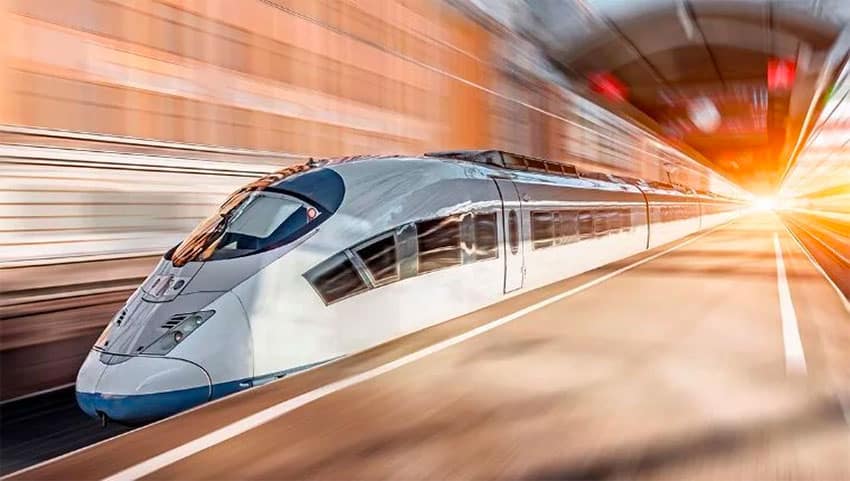
The high-speed passenger rail line between Mexico City and Querétaro, suspended four years ago by the previous federal government, could go ahead through a public-private partnership, says the governor of Querétaro.
Francisco Domínguez Servién told the newspaper El Economista that the Querétaro government will continue to meet with its federal counterpart to discuss the viability of a rail link between the state and national capitals.
The master plan for the project, which was postponed in 2015, is in the hands of the Secretariat of Communications and Transportation (SCT), the governor said.
Domínguez acknowledged that no funds were set aside in the 2020 budget for the rail link but he noted that the right-of-way for its construction has already been obtained.
He said he hoped to meet with officials from President López Obrador’s office as well as representatives of Canadian manufacturer Bombardier to discuss the possibility of establishing a public-private partnership to complete the project.
“. . . Remember that Bombardier, their train division, is in Mexico, in Hidalgo . . .” Domínguez said.
Two months before he was sworn in as president, López Obrador announced that Bombardier would make the rail cars for the Maya Train at its Ciudad Sahagún plant.

El Economista said the company could also play a key role in the revival of the Mexico City-Querétaro project.
Domínguez said the railroad would trigger economic development in Querétaro and the wider Bajío region and would also be of “great utility” for Mexico City.
In contrast to the previous government’s plan to run only passenger trains on the line, the current proposal is for freight trains to use it as well, the governor said. The aim of that proposal is to ensure that the rail project doesn’t operate at a loss, Domínguez explained.
Communications and Transportation Secretary Javier Jiménez Espriú said even before he took office that the Mexico City-Querétaro project was part of the government’s transportation plans.
He reiterated in February that the López Obrador administration remains interested in carrying out the project and estimated that an investment of 50 billion pesos (US $2.6 billion) would be required.
Jiménez is expected to travel to Querétaro on Thursday to discuss a range of issues with state officials.
Under the previous government’s plan, the 210-kilometer train would have carried up to 23,000 passengers a day at speeds up to 300 km/h. Traveling time between the two cities was to be 58 minutes.
A decision to revive the rail link would add to an already ambitious infrastructure plan being pursued by the government.
Among the projects the López Obrador administration intends to build are the Santa Lucía airport in México state, a new oil refinery on the Tabasco coast, the Maya Train railroad on the Yucatán peninsula and a trade corridor on the Isthmus of Tehuantepec between Salina Cruz, Oaxaca and Coatzacoalcos, Veracruz.
Source: El Economista (sp)