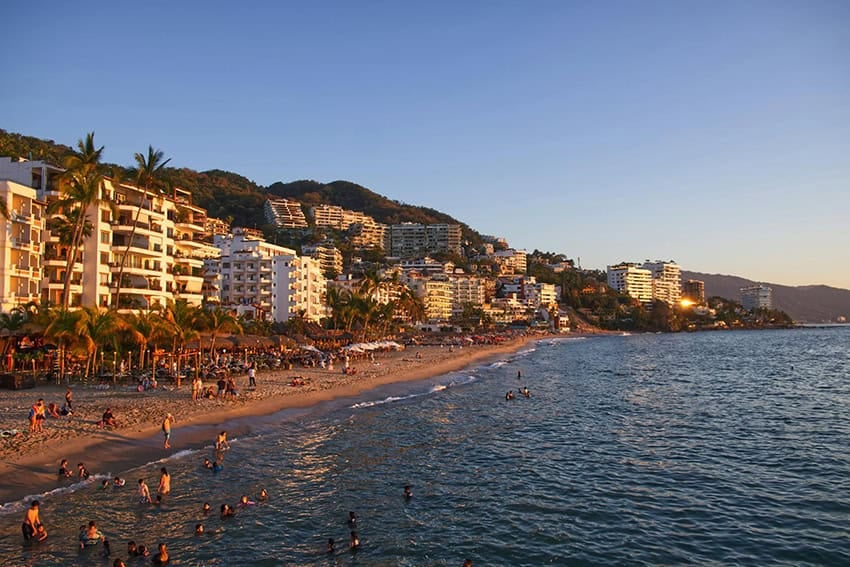
Days after Mexico’s Supreme Court tossed out a tax on foreign tourists, calling it “vague and unconstitutional,” Puerto Vallarta municipal authorities say they have addressed the Court’s concerns and will apply the fee beginning Jan. 1.
Municipal treasurer Raúl Rodrigo Pérez informed a local media outlet that the City Council made the modifications requested by the Supreme Court and expects the new wording to be approved in time to begin collecting the tax next year.

The municipal government had anticipated the Court’s ruling, Pérez said, and had been preparing its response.
“We had expected this scenario,” he said. “We knew it could happen, and we knew how to resolve it since the ruling offered solutions that were implemented.”
On Dec. 1, the Court annulled a tax reform approved in 2024, ruling that the tax — a one-time annual 160 peso fee (US $9) — failed to adhere to two key constitutional principles: tax legality and legal certainty.
The Court determined that the regulation contained ambiguous wording, and did not precisely define the specific services, public goods or spaces for which the payment was being collected.
It further said that the ambiguity of the tax left foreign tourists uncertain about the purpose of the mandatory payment, allowing for the potential arbitrary enforcement by the authorities.

Addressing the consideration that a tax must be clearly and reasonably linked to the cost and provision of a specific public service, the municipal government reworded its revenue bill to clarify that the revenue generated will be used for public works and, in general, tourism infrastructure.
The municipal government sent the corrected regulation to the state Congress last week which quickly approved it.
Pérez is confident that all necessary steps were taken to win approval from the Court.
“I’m sure that starting in January, we will begin collecting the new tax, which will translate into more projects for Puerto Vallarta,” he said.
Pérez defended the tax proposal, saying it is not coercive. “It’s a request for support so that each time [tourists] come to Puerto Vallarta, they find it even more beautiful,” he said.
The collection process is designed to be simple and non-intrusive. The cruise ship terminal, the airport and local hotels will provide information to visitors. Tourists will be able to contribute at hotel lobbies, specialized modules and designated Treasury offices, all staffed by trained personnel, Pérez said.
The tax was proposed by Puerto Vallarta Mayor Luis Ernesto Munguía and approved by the state Congress in November 2024. It was expected that the tax would generate 200 million pesos (US $11 million) annually for the municipality.
The Court took up the case after the National Human Rights Commission filed a constitutional challenge asserting that Article 80 of Puerto Vallarta’s 2025 Revenue Law lacked precision and violated principles of tax certainty.
With reports from Reforma, Milenio, Tribuna de la Bahia and Banderas News