The long-awaited Guadalajara-Puerto Vallarta highway, which makes it easier and faster to reach the Pacific resort cities of Puerto Vallarta and Bahía de Banderas by car, is finally fully open — 13 years after work on the 310-kilometer roadway was first approved.
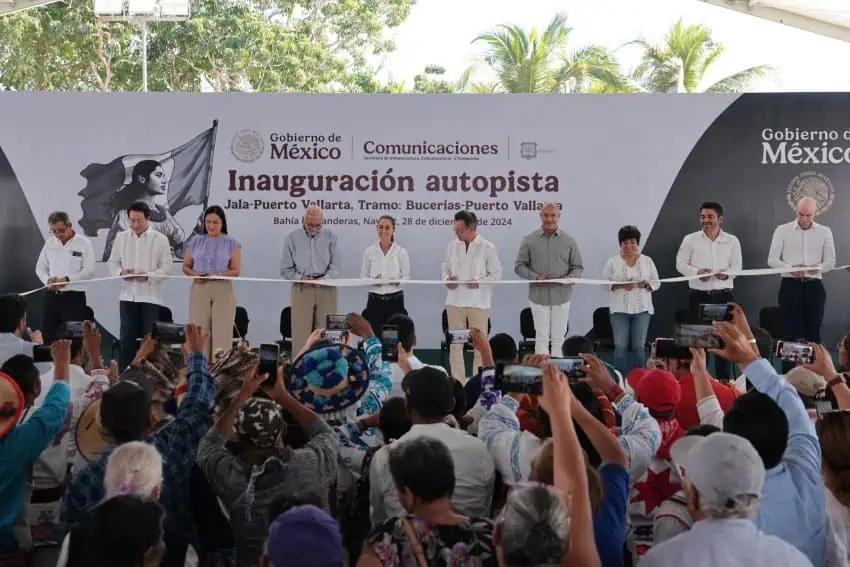
An inaugural ceremony on Satuday in Bahía de Banderas led by President Claudia Sheinbaum and members of her cabinet celebrated the opening of the final stretch of the highway — a 33-kilometer segment along the Pacific Coast that extends from Bucerías, Nayarit, to Puerto Vallarta, Jalisco.
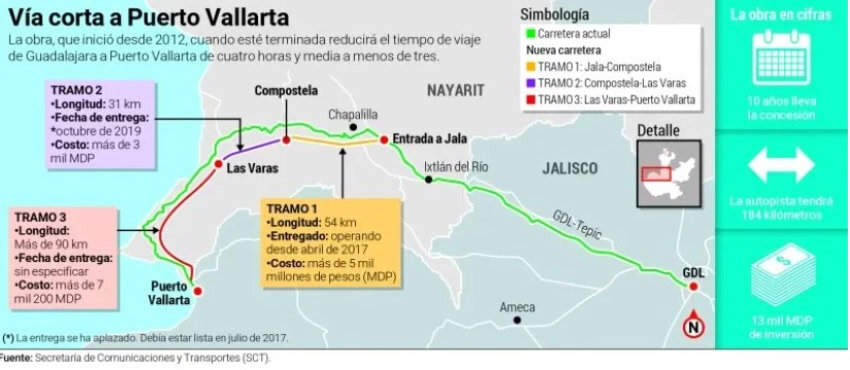
The new roadway also provides a direct link between Tepic, the Nayarit state capital, and the beach resorts in and around Puerto Vallarta, reducing travel time from three hours to 90 minutes.
The strategic infrastructure project has been delayed multiple times over its 13-year duration due to budget constraints — outlasting three of Mexico’s presidents and even more governors of Jalisco and Nayarit.
It was set to open in 2014, but by the time President Enrique Peña Nieto left office in 2018, only two sections of the highway project had opened. Progress on its construction continued on a slow drip in the following years, with sections opening one at a time.
The road loops northwest from the state capital around the Sierra de Vallejo Biosphere Reserve in southern Nayarit, then curves southwest toward the Pacific Ocean, traversing along the coast for nearly 100 kilometers.
The new toll road will reduce travel time between Guadalajara and the coast in half, from five hours to two and a half hours, according to Infrastructure, Communications and Transportation (SICT) Minister Jesús Antonio Esteva. It also benefits travelers farther north along the Jalisco coast, giving them a more direct route to Puerto Vallarta and Guadalajara.

Sheinbaum also announced on Saturday other infrastructure and social projects benefitting the region, including scholarships for children in Nayarit and Jalisco and funding to renovate schools in both states.
Inauguración de la autopista Jala-Puerto Vallarta. Bahía de Banderas, Nayarit https://t.co/YTOCcYI9ZQ
— Claudia Sheinbaum Pardo (@Claudiashein) December 28, 2024
Sheinbaum also took advantage of the highway’s inauguration to announce new funding for upcoming infrastructure and projects to benefit citizens in the two states.
Among the new public works to be constructed are a bridge between Bahía de Banderas and Puerto Vallarta, a freshwater aqueduct in southern Nayarit and several scenic highways — known as caminos artesanales — in the Indigenous Wixárica region of northwestern Jalisco.
The caminos artesanales project seeks to connect Indigenous communities in rural areas and will use local materials. It will also provide temporary jobs to residents.
“We are demonstrating that nobody will be left behind in Mexico,” Sheinbaum said Saturday.
Welfare Minister Ariadna Montiel said that the new highway and the projects Sheinbaum announced demonstrate that the administration is determined to improve the quality of life of Mexico’s marginalized citizens.
The final stretch of highway, which cost 2 billion pesos (US $98 million), features eight bridges — with the longest being 300 meters in length — three overpasses, a trunk road to the Puerto Vallarta airport and one toll booth, according to SICT Minister Esteva.
The entire toll highway has six toll booths and costs as much as 1,300 pesos (US $63) to travel its entire length, according to the newspaper Informador.