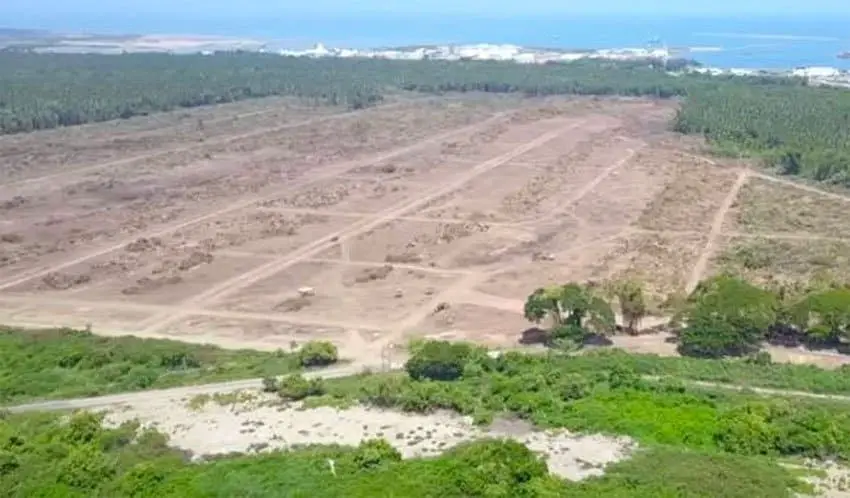
Two environmental organizations have warned that the government cannot legally start construction of the new oil refinery on the Tabasco coast on June 2 because it hasn’t obtained the required permits.
President López Obrador said yesterday that his administration has “prior authorization” to begin work on the Dos Bocas refinery, declaring “I’m going to initiate the works . . . on Sunday.”
He added that if any additional permits are needed, they will be obtained.
The president announced earlier this month that the state oil company and the Secretariat of Energy (Sener) will build the refinery because the bids made by private companies were too high and their estimated time frames to complete the project were too long.
The government says the refinery, which will be Mexico’s seventh, will be built for US $8 billion and be ready to operate in May 2022.
Last week, Energy Secretary Rocío Nahle said that environmental approval for the project was issued after the government presented a 2012 environmental impact statement (EIS) to the Security, Energy and Environmental Agency (ASEA).
The study was prepared for an oil field with 93 wells that had been proposed for the refinery site.

But the Mexican Center for Environmental Law (Cemda) and Greenpeace said in a statement that the project doesn’t have the required permits as stipulated by environmental laws.
“We reiterate that to this day, an environmental impact statement that corresponds specifically to the refinery project has not been submitted to [ASEA],” they said.
“Therefore, that department has not started the evaluation of the corresponding environmental impact and consequently there is no favorable environmental impact ruling that allows the project in question to go ahead.”
The environmental groups added that the permits referred to by Energy Secretary Nahle “correspond to wells approved in 2012” and “cannot be used to justify the commencement of another completely different project.”
In that context, Cemda and Greenpeace urged the new environment secretary, Víctor Manuel Toledo Manzur, and the chief of ASEA to advise the president that the refinery project cannot begin this weekend.
They said that if the government starts work on the refinery on June 2 “without having submitted an environmental impact statement to the respective evaluation process and without having requested [permission] to change the land use” it will be guilty of a breach of the law.
At his morning press conference yesterday, López Obrador asked Toledo to offer his opinion about the project’s permits on Friday before reiterating that rescuing the oil and energy sectors is a priority for his government.
“After being self-sufficient [in petroleum], irresponsible technocrats – neoliberals – led us to only produce 200,000 barrels [per day] because they deliberately allowed the refineries to be ruined,” he said.
The president has pledged to reduce Mexico’s reliance on petroleum imports, most of which come from the United States. Building the Dos Bocas refinery and upgrading the existing ones will enable the country to once again become self-sufficient for its fuel needs, he claims.
Construction of the Tabasco refinery is expected to create 23,000 direct jobs and 112,000 indirect ones and, according to the government, it will have the capacity to produce 340,000 barrels of petroleum a day.
Despite Pemex having limited experience in building refineries, López Obrador is confident the project will be a success.
But outside the government, there was widespread criticism of the decision to scrap the bidding process in which four specialized international energy firms participated, and skepticism that the state oil company has the technical capacity to execute the refinery project.
Source: Milenio (sp)