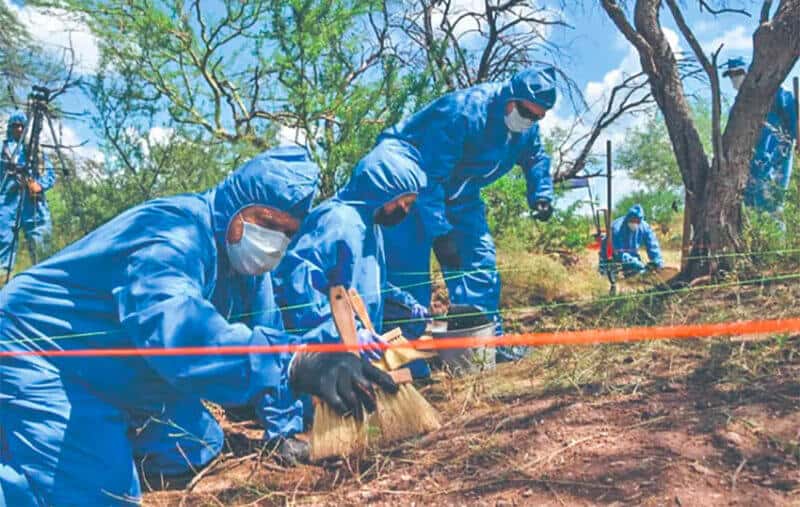
DNA tests on six sets of skeletal remains found in Sonora were identified Monday as five of seven Yaqui men who disappeared in July.
The men, aged between 27 and 65, disappeared while transporting cattle in Loma de Bácum, about 30 kilometers from Ciudad Obregón. Three other men from Loma de Bácum were kidnapped alongside the Yaqui men, but are not among those identified, according to news website 24 Horas. Five other men were also kidnapped, but were later released.
The skeletal remains were discovered on nearby Chichiquelite Hill on September 19.
The state Attorney General’s Office said more bone fragments and possessions had been found in the surrounding area, suggesting some of the still missing men may also have died there. It did not suggest a motive for their deaths, but has previously implied the involvement of drug cartels or affiliated gangs.
State Attorney General Claudia Contreras said that investigators searching for the disappeared men came under automatic rifle fire near the skeletons. The investigators returned fire, killing two of the assailants, before discovering the barely buried remains.
There has been a big increase in violence in the last year in southern Sonora.
Yaqui leader and water rights activist Tomás Rojo Valencia was murdered in May. Earlier that month, Abel Murrieta Gutiérrez, a former Sonora attorney general who was running for mayor of Cajeme, was murdered in broad daylight. In June, Yaqui environmental activist Luis Urbano was shot dead in downtown Ciudad Obregón.

Alberto Vizcarra, a leader of the Sonora Citizen’s Movement for Water, said the fight over water may ultimately be behind the killings. “What they did to Tomás [Rojo Valencia] was a political crime,” he said.
At the time of Rojo’s murder, the Attorney General’s Office pointed to tensions and money raised at highway blockades as possible motives. Prosecutors said the Yaqui leader had been trying to install a toll booth on a main highway that runs through their territory.
President López Obrador has consistently made his sympathies for the Yaqui community clear. He led a ceremony in southern Sonora on Tuesday to ask forgiveness for a government campaign to exterminate or exile their ancestors around the turn of the 20th century. He has committed to improving rights over ancestral resources like water — for which there is fierce competition in the state — and providing land concessions and federal investment.
“We came to endorse our commitment to do justice for the Yaqui peoples, first we want to ask them for forgiveness for state crimes against their ancestors during the dictatorship of Porfirio Díaz and we are also here to try to repair as much as possible the damage to the Yaqui peoples,” he said.
The Yaquis stubbornly fought the government’s brutal campaign to eliminate the tribe in the late 1800s and early 1900s. They were largely defeated by 1900 and Díaz began moving them off their fertile farmland to less valuable territory or to virtual enslavement on haciendas as far away as Yucatán.
The government is investing 11.6 billion pesos in Yaqui communities, including a 158-kilometer aqueduct to deliver potable water to 40,000 people.
With reports from 24 Horas, Forbes México and AP News